AI Agent vs Chatbot: What's the Difference? (2026 Guide)
Ask a chatbot "my package hasn't arrived, where is it?" and you'll get a helpful paragraph explaining how to track packages.
Ask an AI agent the same question and it looks up your order, checks the carrier's API, sees the package has been stuck at a facility for four days, opens a claim, and replies: "It's been stuck in transit since Monday — I've filed a claim and a replacement ships tomorrow."
Same question. Same underlying AI model, even. Completely different outcome.
"AI Agent" and "chatbot" get used interchangeably in marketing, which makes the distinction feel fuzzy. It isn't. The difference is architectural, it's easy to understand, and it determines what you can actually automate. This guide breaks it down with real examples — and helps you decide which one you need.
The 30-Second Answer#
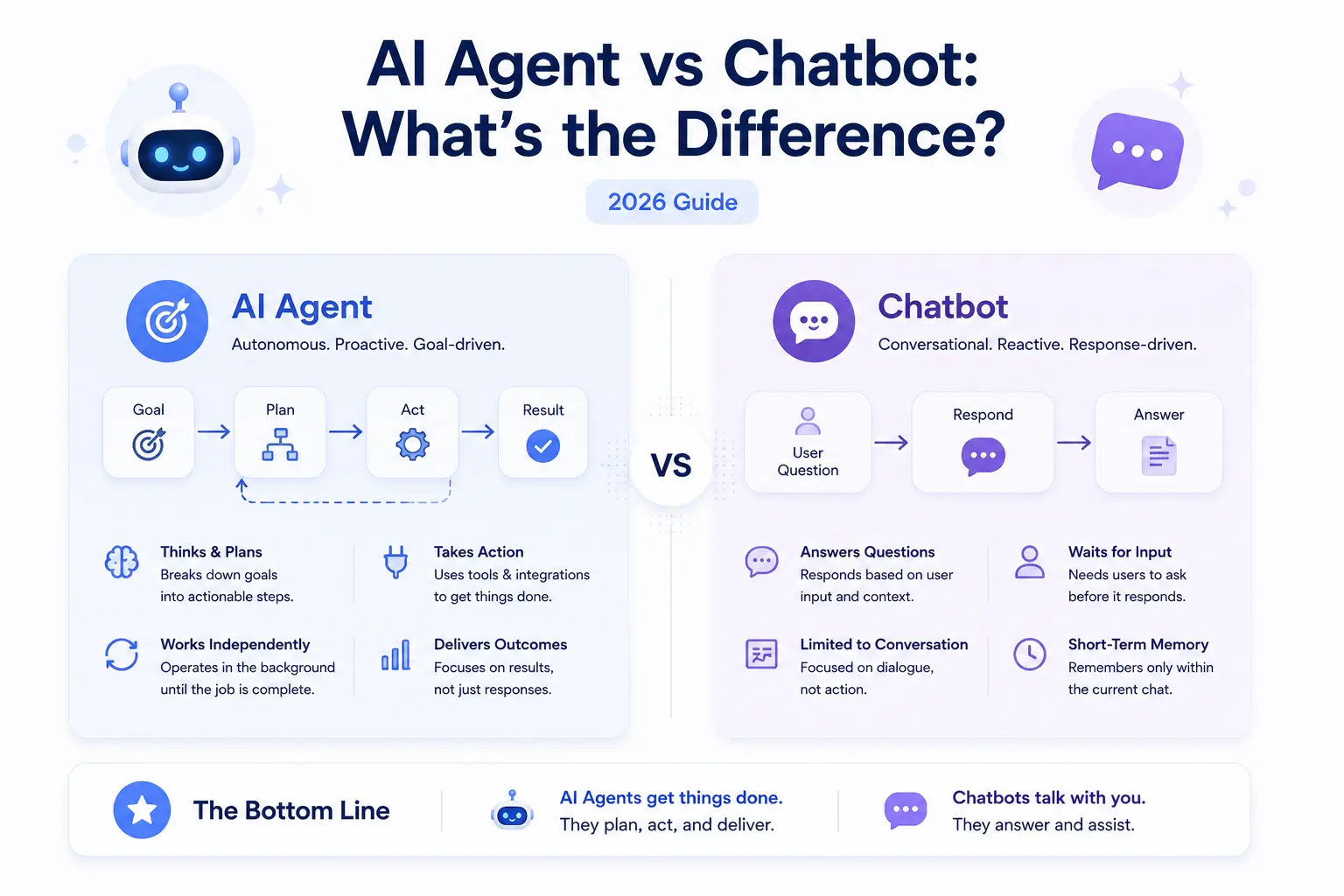
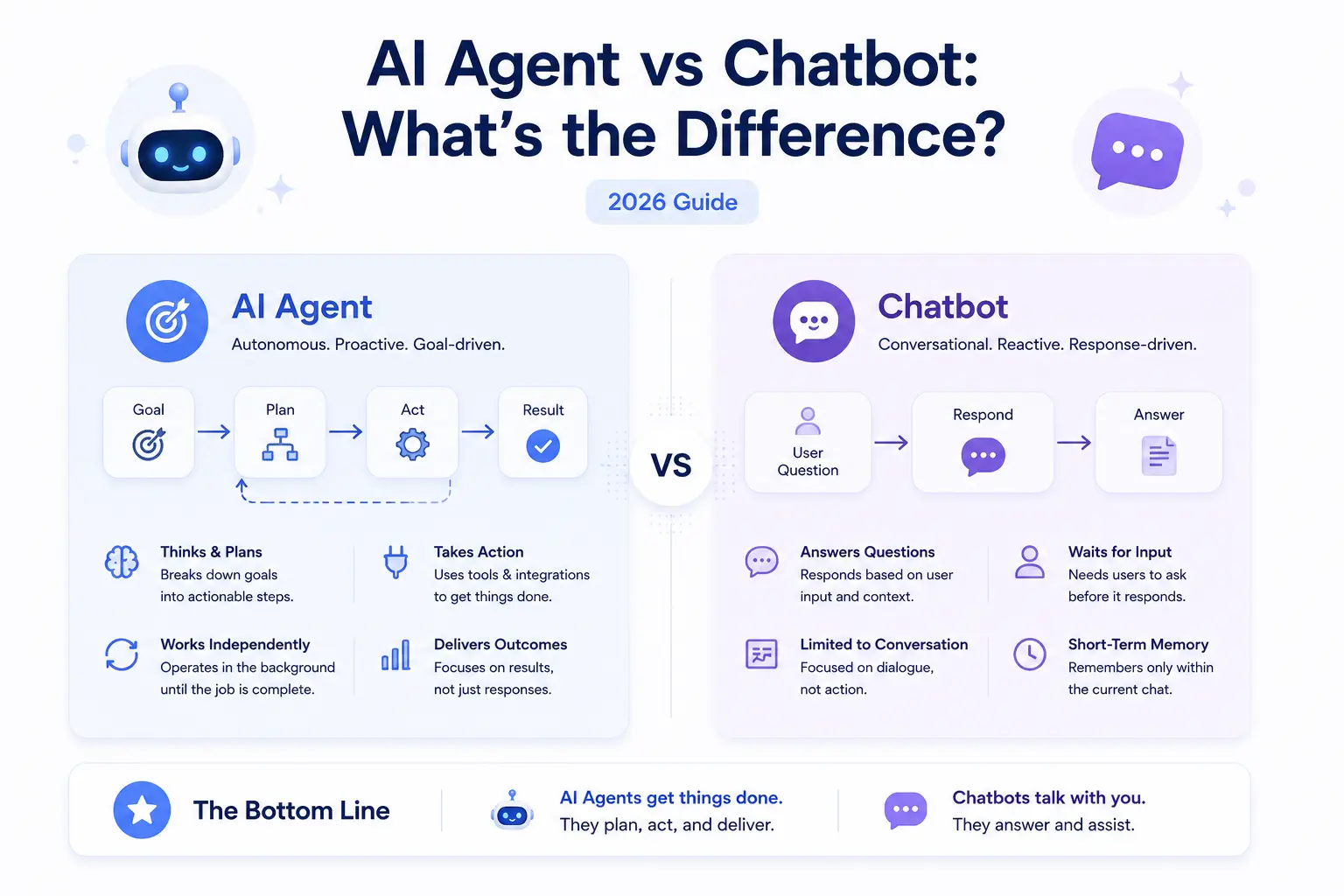
A chatbot responds. An AI agent accomplishes.
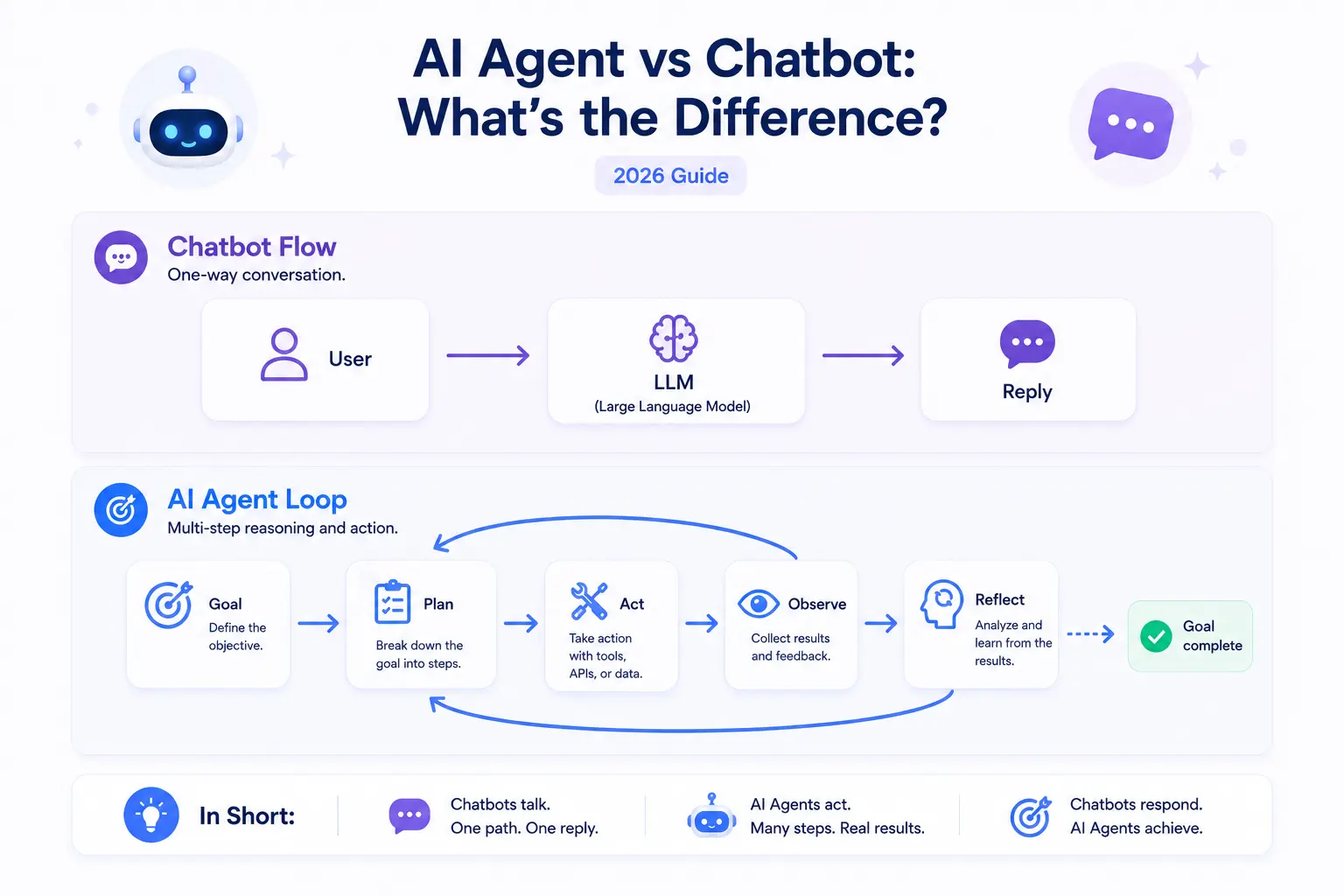
A chatbot receives your message, generates the best possible reply, and stops. Its unit of work is a response. An AI agent receives a goal, then plans, uses tools, checks its own results, and keeps working — through as many steps as needed — until the goal is done or genuinely can't be. Its unit of work is an outcome.
| Chatbot | AI Agent | |
|---|---|---|
| Input | A message | A goal |
| Output | A reply | A completed task |
| Steps taken | One | As many as needed |
| Uses tools? | Rarely, and only when asked | Constantly, by its own decision |
| Memory | Current conversation | Conversation + long-term memory |
| Handles errors by | You rephrasing your question | Retrying a different approach itself |
| Autonomy | None — you drive every turn | High — it drives itself between check-ins |
Everything else in this article is that table, explained properly.
What Is a Chatbot?#
A chatbot is software that holds a conversation. The category spans two very different generations:
Rule-based chatbots (the ones that gave chatbots a bad name) match your message against scripted patterns: press 1 for billing, type "refund" to get the refund macro. They can't handle anything their designers didn't anticipate, which is why "Sorry, I didn't understand that" became a meme.
LLM chatbots changed everything in late 2022. Built on large language models, they genuinely understand free-form language and can discuss almost anything — draft emails, explain concepts, debug code, translate, summarize. ChatGPT in its original form is the defining example. If you're hazy on how LLMs pull this off, our guide on how large language models work explains it from scratch.
Modern LLM chatbots are remarkable. But notice the shape of every interaction: you say something, it says something back, and then it waits. The conversation only moves because you keep pushing it. The chatbot never acts on the world — it only ever talks about it.
What Is an AI Agent?#
An AI agent uses that same LLM — the same "brain" — but wraps it in an architecture that lets it do things:
- A loop instead of a single response: perceive → plan → act → observe → reflect, repeated until the goal is met.
- Tools: web search, APIs, code execution, file access, email — the hands that touch the real world.
- Memory beyond the current chat, so it can carry context across steps and sessions.
- Self-correction: when a step fails, it reads the error and tries another way — without you asking.
We've covered each component in depth in How AI Agents Work: Complete Architecture Explained, and the beginner-friendly big picture in What Is an AI Agent?. For this comparison, one sentence is enough: an agent is an LLM given a loop, tools, and memory — and the license to use them on its own judgment.
The Five Differences That Actually Matter#
1. Autonomy: Who Drives the Conversation?#
With a chatbot, you are the loop. You ask, read the answer, decide what to ask next, and steer every turn. The intelligence is impressive, but the process runs on your effort. Stop typing and everything stops.
An agent internalizes that loop. Give it "find me three flight options to Tokyo under $800 and hold the best one," and the deciding-what-to-do-next happens inside the system: search, filter, compare, hold, report back. You're consulted at checkpoints — not conscripted as the project manager of every step.
This is the deepest difference, and it's why the industry uses the word agentic: the system has agency between your check-ins.
2. Tools: Talking About the World vs Touching It#
A pure chatbot's only ability is generating text. It can describe how to book a meeting room, write the email you could send, tell you what commands to run. Knowledge without hands.
An agent has hands — tool calling. It doesn't tell you how to book the room; it calls the calendar API and books it. It doesn't print terminal commands; it runs them, reads the output, and reacts. The mechanics — how a model emits a structured tool request and a runtime executes it safely — are covered in the architecture guide, but the practical consequence is simple: chatbot output always needs a human to carry it into the world. Agent output is the change in the world.
3. Memory: Goldfish vs Colleague#
A chatbot remembers your current conversation — and typically nothing else. Open a new chat, and you're strangers again. Explaining your project's context for the fifth time is the tax every chatbot user pays.
Agents are built with memory layers: short-term working memory for the task at hand, and long-term memory that survives across sessions — your preferences, past decisions, project conventions. That's what makes the fifth interaction better than the first, the way a colleague gets more useful the longer they work with you. For the full picture — memory types, vector databases and retrieval — read AI Agent Memory Explained.
4. Goal Pursuit: One Shot vs Until It's Done#
A chatbot optimizes for the best possible next response. If that answer is wrong or incomplete, the correction cycle runs through you.
An agent optimizes for the goal. It decomposes "launch my newsletter signup page" into steps, works through them, and — critically — verifies its own work along the way: did the page deploy? Does the form actually submit? A chatbot that writes broken code hands it to you with confidence; a coding agent runs the tests, sees the failure, and fixes it before you ever see it.
5. Error Handling: "Try Rephrasing" vs "Trying Another Way"#
When a chatbot's answer misses, your recourse is rephrasing the prompt. When an agent's step fails — an API times out, a page doesn't load, a test breaks — the failure lands back in its context, and the next loop iteration responds to it: retry, work around, or escalate to you with specifics. Resilience is built into the loop rather than outsourced to your patience.
Same Task, Both Systems: A Concrete Walkthrough#
Task: "Refund order #4821 if it qualifies under our policy."
Chatbot version:
"To process a refund, first check whether the order is within the 30-day window, then verify the item category is refundable, then open your payments dashboard and select 'Issue refund'..."
Accurate, well-written — and now you do six steps of work.
Agent version:
- Calls
get_order(4821)→ purchased 12 days ago, electronics. - Retrieves the refund policy from memory → electronics: 30-day window, no restocking fee.
- Reasons: qualifies.
- Calls
issue_refund(4821)→ payment API confirms. - Calls
send_email(customer, ...)→ confirmation sent. - Reports: "Refunded $149 to the original card and emailed the customer. Order was well within policy."
Six steps happened either way. The difference is who performed them.
When a Chatbot Is All You Need#
Agents are not "chatbots but better" — they're a different tool with real costs. A chatbot is the right choice when:
- The output is the product. Drafting, explaining, brainstorming, translating, summarizing — if what you want is text, a single high-quality response is the whole job.
- You want to stay in the driver's seat. Learning a topic, exploring ideas, making judgment calls — the back-and-forth is a feature, not friction.
- Stakes are high and actions are irreversible. Sometimes "tell me what you would do" is exactly the safety margin you want.
- Budget and simplicity matter. One model call is cheap and predictable. An agent run is many calls — often 10–100× the tokens — plus engineering for tools, permissions and monitoring.
When You Actually Need an Agent#
Reach for an agent when:
- The task is multi-step and tool-dependent — research across many sources, operations on real systems, anything with "then... then... then..." in its description.
- It repeats. A workflow you run weekly is exactly what an agent should own end-to-end.
- Completion matters more than conversation. You don't want an essay about the fix; you want the fix, verified.
- Value scales with autonomy. Support ticket resolution, codebase migrations, data pipeline babysitting — work where every human touchpoint you remove compounds.
The Line Is Blurring (By Design)#
Here's the part that trips people up in 2026: the products are converging. ChatGPT ships agent modes that browse and execute tasks. Claude powers both a chat interface and coding agents that run for hours. Copilot ranges from autocomplete to autonomous pull requests. Ask "is ChatGPT a chatbot or an agent?" and the honest answer is: it's a chat interface that escalates into an agent when the task demands it.
That's not marketing confusion — it's the correct architecture. Conversation is the natural interface; agency is the natural engine. The distinction that stays meaningful isn't which product you're using, but which mode of work is happening: is the AI producing a response, or pursuing an outcome? (How ChatGPT, Claude, Cursor, Perplexity and Copilot each sit on this spectrum is mapped product by product in AI Agent vs AI Assistant. And if you're choosing a daily driver, see our ChatGPT vs Claude comparison.)
FAQ#
Is ChatGPT a chatbot or an AI agent? Both, depending on mode. In a plain conversation it's a chatbot. When it browses, runs code, or executes a multi-step task with tools, it's operating as an agent.
Are AI agents just chatbots with plugins? No. Tools alone give a chatbot hands, but an agent also needs the loop — planning, observing results, self-correcting — plus memory. A chatbot with plugins still waits for you to drive every step. The architecture guide shows exactly what the loop adds.
Are agents always better since they're more capable? No. Agents cost more per task, need guardrails around real-world actions, and add failure modes chatbots don't have. For text-only jobs, a chatbot is faster, cheaper, and safer.
Will agents replace chatbots? The interfaces are merging into "chat that can escalate to action." The response-mode itself isn't going anywhere — most questions still just need an answer, not an autonomous system.
Keep Learning#
Part of the FindUrAI AI Agent series:
- The pillar: What Is an AI Agent? Complete Beginner Guide
- How AI Agents Work: Complete Architecture Explained — the loop, tools and memory in depth
- How Large Language Models Work — the brain both systems share
- ChatGPT vs Claude (2026) — choosing a daily assistant
- AI Agent Memory Explained — the layer that turns a goldfish into a colleague
- What is AI Engineering & How to Start — building these systems as a career
Also in this series: AI Agent vs AI Assistant — the autonomy spectrum, product by product.