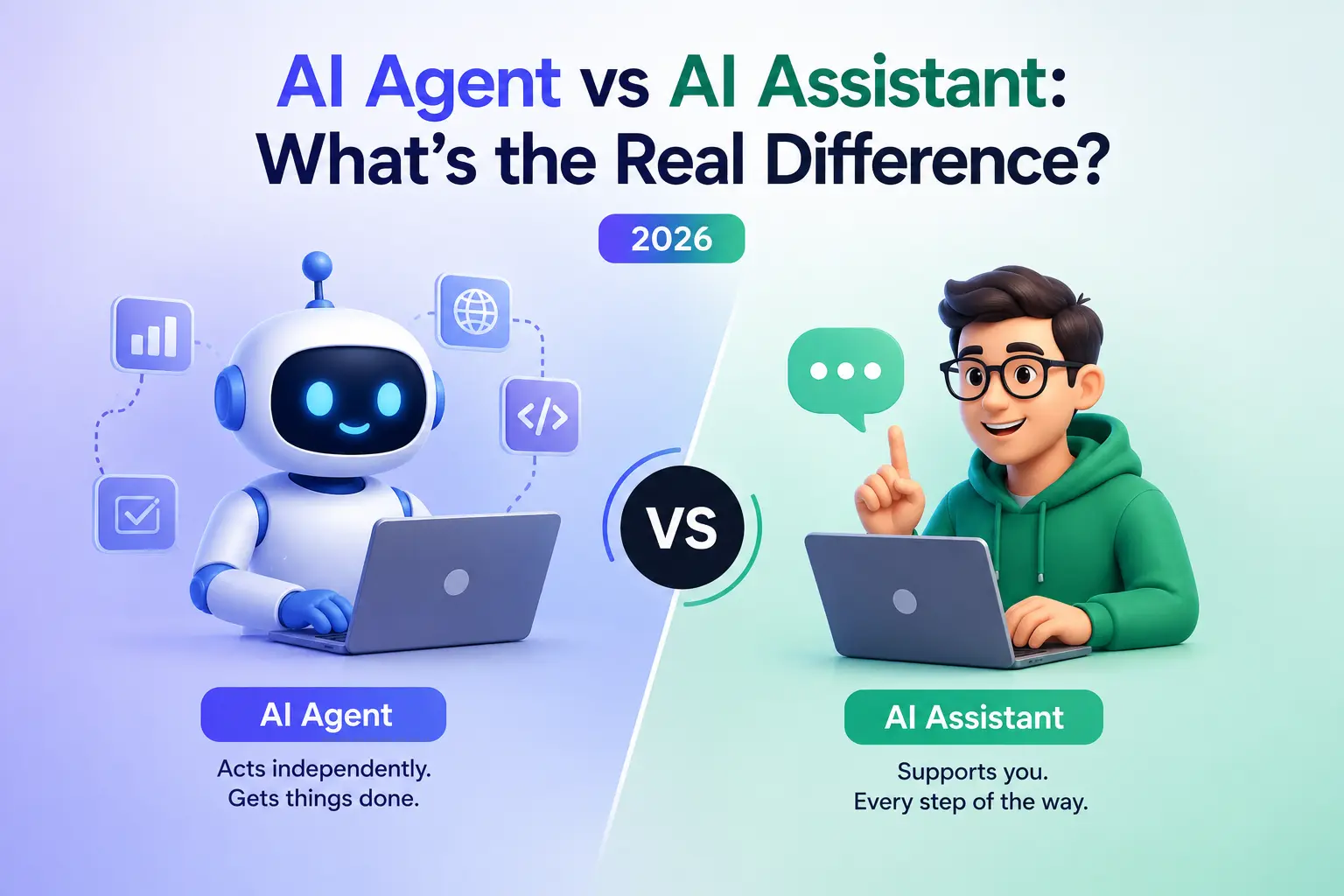
AI Agent vs AI Assistant: What's the Real Difference? (2026)
ChatGPT calls itself an assistant — and ships agent modes. Copilot is named after the ultimate assistant metaphor — and now opens pull requests on its own. Cursor autocompletes your next line one minute and refactors your codebase unsupervised the next.
So when someone asks "is Claude an assistant or an agent?" the honest answer is: that's the wrong question. Assistant and agent aren't rival product categories — they're modes of working on a single spectrum of autonomy. Every major AI product in 2026 lives somewhere on that spectrum, and most of them slide along it depending on what you ask for.
This guide defines both modes precisely, maps the five products everyone actually uses — ChatGPT, Claude, Cursor, Perplexity, Copilot — onto the spectrum, and gives you a practical rule for choosing the right mode for a task. It's part of our AI Agent series anchored by What Is an AI Agent?.
Definitions That Actually Hold Up#
An AI assistant amplifies a human who stays in the loop. You direct; it accelerates. It drafts, suggests, completes, explains — and after every contribution, control returns to you. The work is a duet, and you're conducting. The session shape is conversational: turn, turn, turn.
An AI agent executes a goal with the human out of the loop between checkpoints. You delegate; it delivers. It plans steps, calls tools, checks its own work, and comes back when the job is done or a decision genuinely needs you. The session shape is a briefing followed by a result.
Notice this is not the same split as AI Agent vs Chatbot. A chatbot lacks the machinery to act (no tools, no loop). An assistant often has the full agent machinery — tools, memory, planning — but deploys it in short, supervised bursts. The chatbot distinction is about capability; the assistant/agent distinction is about who holds control.
Three questions locate any product interaction on the spectrum:
- Who initiates the next step — you, or the system?
- How long does it work unsupervised — seconds, or an hour?
- What comes back — a suggestion for you to act on, or a completed change in the world?
The Spectrum, Product by Product#
ChatGPT — an assistant that escalates#
Default ChatGPT is the canonical assistant: you prompt, it responds, you steer. But hand it a research question and switch on its agentic mode, and it will browse, gather, cross-check and compile for many minutes without you — then return a finished report. Same product, both ends of the spectrum. The interface stays a chat; the mode of work changes underneath.
Claude — a conversation partner and a long-running worker#
Claude's chat interface is assistant-mode: thinking partner, writer, analyst. But the same model powers Claude Code, which will take "migrate this codebase off the deprecated API" and grind through it — editing files, running tests, fixing failures — for extended stretches, checkpointing with you at meaningful decisions. Claude is the clearest illustration that assistant vs agent is a property of the deployment, not the model.
Cursor — both modes in one editor#
Cursor is the most instructive example because you can feel the spectrum while using it. Tab-completion and inline edits are pure assistant: suggestions at your cursor, accepted or rejected keystroke by keystroke. Its background/agent mode is pure agent: describe the outcome, and it plans across files, edits, runs, and iterates while you do something else. Developers slide between the modes dozens of times a day — assistance for work they want to shape, agency for work they want done.
Perplexity — assistant on the surface, agent underneath#
Perplexity looks like simple Q&A, but each query quietly runs a small agent loop: decompose the question, search, read sources, synthesize with citations. The autonomy is real but bounded and brief — seconds, not hours, with no side effects on your world. It's a useful reminder that "agent" isn't all-or-nothing: you can productize a tight, safe slice of autonomy.
GitHub Copilot — from autocomplete to teammate#
Copilot began as the purest assistant in software — grey text suggestions in your editor. In 2026 it spans the whole spectrum: chat explanations (assistant), and a coding agent you can assign an issue to, which works in the background and returns a pull request for review (agent). The PR is the perfect agent artifact: completed work, formally submitted for human judgment.
| Product | Assistant mode | Agent mode | Where control sits |
|---|---|---|---|
| ChatGPT | Chat, drafting, analysis | Agentic research & task modes | You, until you delegate a task |
| Claude | Chat thinking partner | Claude Code long-running tasks | Checkpoints on big decisions |
| Cursor | Tab completion, inline edits | Multi-file background agent | Slides per-task, dozens of times a day |
| Perplexity | Q&A interface | Bounded search-loop per query | Always you — autonomy lasts seconds |
| Copilot | Inline suggestions, chat | Issue-to-pull-request agent | You review the PR, not the steps |
 Image to place: the five products plotted on the autonomy spectrum as a labeled scatter — each product shown as a bar spanning its range (e.g. Perplexity a short bar near the middle, Cursor and Copilot long bars spanning both ends). Path:
 public/blogsimages/aiagent/ai-agent-vs-ai-assistant/diagram-1.webp
What Actually Changes Between the Modes#
Responsibility. In assistant mode you implicitly review everything, because every output passes through your hands on its way into the world. In agent mode, review becomes an explicit, designed step — a checkpoint, an approval, a PR. Skipping that design is how "the agent sent the wrong email" stories happen.
Skill of use. Assistants reward prompting — expressing the next thing you want. Agents reward specifying — expressing the outcome, constraints and success criteria up front, because you won't be there mid-task to clarify. Writing a good agent brief is closer to writing a good ticket than a good message. (The machinery that makes delegation trustworthy — planning and self-checking — is covered in AI Agent Planning Explained.)
Economics. Assistant interactions cost one model call; agent runs cost dozens to hundreds, plus the architecture around them. The math flips when the task is long: an hour of your attention saved outweighs the tokens spent many times over.
Which Mode Does Your Task Need?#
A rule that holds up remarkably well:
If your judgment improves the work at every step, use an assistant. If your judgment is only needed at the start and the end, use an agent.
Writing something with your name on it, exploring a hard problem, making design decisions — judgment-dense work; stay in the loop. Migrations, research sweeps, bulk fixes, report generation — judgment-sparse in the middle; delegate, then review the result.
And because every major product now offers both modes, this is no longer a purchasing decision — it's a per-task habit. The professionals getting the most out of AI in 2026 aren't the best prompters; they're the best at deciding, task by task, which mode to invoke.
FAQ#
Is "copilot" just a marketing word for assistant? It started that way — the aviation metaphor is exactly right for supervised assistance. But products named Copilot now ship agent modes, so read the feature, not the brand.
Can an assistant become an agent with a bigger model? No — the difference is architectural and interactional, not intelligence. Agent mode needs a loop, tools, checkpoints and a runtime (full breakdown here), plus an interface built around delegation rather than turns.
Which is "better"? Wrong axis. Assistants maximize your throughput on judgment-dense work; agents maximize total throughput on delegable work. Strong teams use both daily.
Keep Learning#
Part of the FindUrAI AI Agent series:
- The pillar: What Is an AI Agent? Complete Beginner Guide
- AI Agent vs Chatbot — the capability distinction underneath this one
- How AI Agents Work: Complete Architecture Explained — the machinery agent mode switches on
- AI Agent Planning Explained — why delegation is trustworthy at all
- ChatGPT vs Claude (2026) — choosing between the two biggest assistants
Also in this series: Single-Agent vs Multi-Agent Systems — what happens when one agent isn't enough.