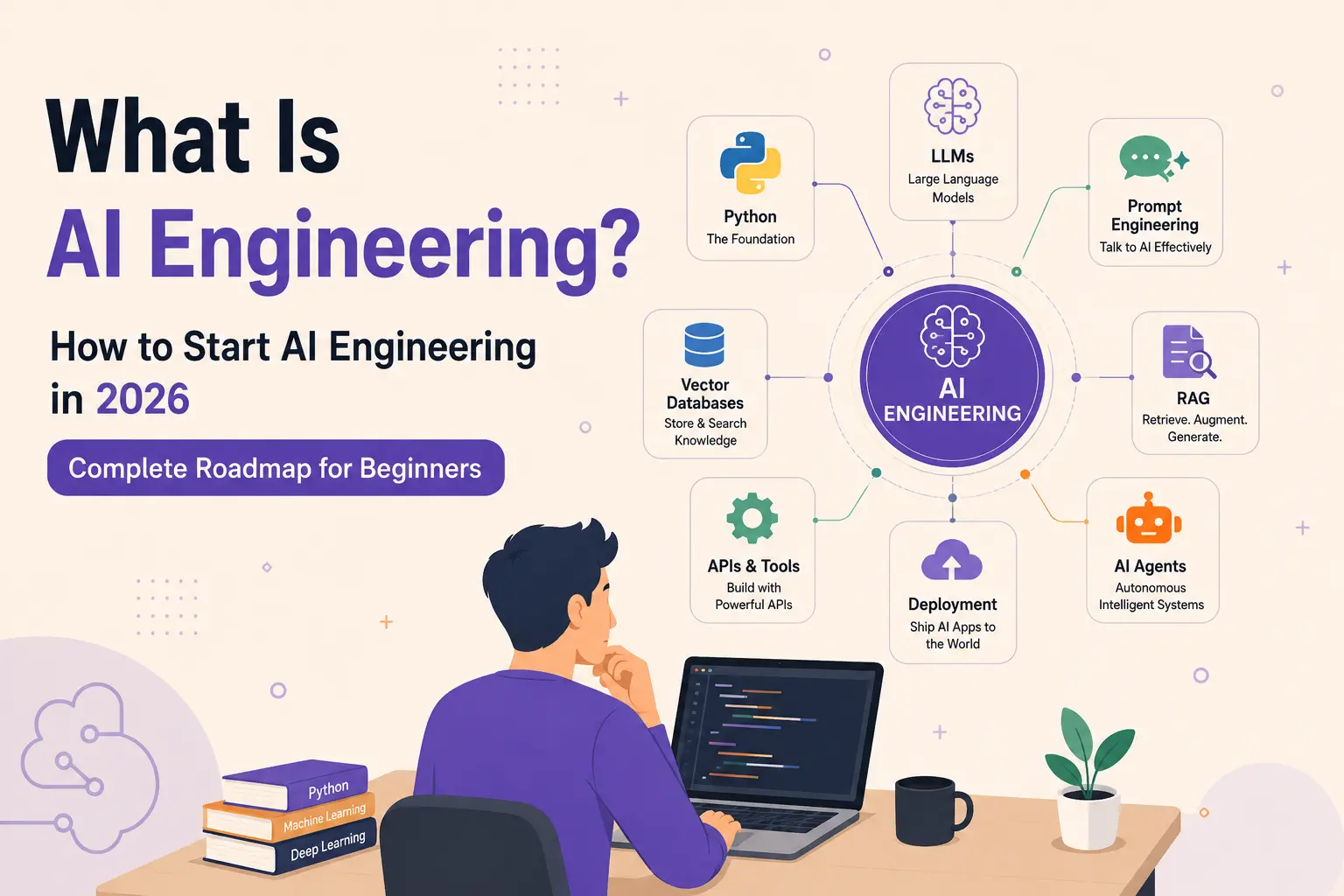
What Is AI Engineering? How to Start AI Engineering in 2026 (Complete Roadmap for Beginners)
"AI Engineer" has become one of the fastest-growing job titles in tech — LinkedIn, Indeed, and levels.fyi all show explosive growth in postings since 2023 — yet most people still confuse it with machine learning engineering or data science. The confusion is costly: beginners spend months studying calculus and neural network theory they'll never use, while the actual skills employers want — prompting, RAG, agents, evals — go unlearned.
This guide fixes that. We'll explain what AI engineering actually is, how it differs from adjacent roles, what the day-to-day work looks like, and then walk through a detailed, step-by-step roadmap you can follow to start AI engineering from scratch in 2026 — even without a computer science degree.
What Is AI Engineering?#
AI engineering is the discipline of building applications on top of foundation models — large language models (LLMs) like Claude, GPT, and Gemini — rather than training models from scratch.
This distinction matters more than it sounds. For the first two decades of applied machine learning, building an "AI feature" meant a long pipeline: collect data, label it, choose an architecture, train a model, evaluate it, deploy it, retrain it when it drifted. That work required specialized ML knowledge, serious math, and expensive infrastructure.
Foundation models flipped the equation. Today, staggering amounts of general intelligence are available behind a simple API call. The hard problem is no longer creating intelligence — it's engineering with it: making model behavior reliable, connecting models to real systems and data, controlling costs, and proving quality. That engineering layer is the AI engineer's job:
- Designing prompts and system instructions that make models behave consistently and safely
- Connecting models to tools, APIs, and databases through tool use (function calling)
- Building retrieval systems (RAG) so models can answer questions from your company's own data instead of hallucinating
- Orchestrating agents — multi-step systems where the model plans, acts, checks its work, and iterates
- Evaluating and monitoring AI features in production, so quality is measured rather than vibes-based
- Optimizing cost and latency with caching, batching, and model routing
The term was popularized by Shawn "swyx" Wang's 2023 essay The Rise of the AI Engineer and cemented by Chip Huyen's 2025 book AI Engineering. The core insight of both: foundation models turned AI from a research problem into an engineering problem. You no longer need a PhD to build AI products — you need solid software engineering skills plus a new, learnable layer of model-specific knowledge.
A simple mental model#
Think of the modern AI stack as three layers:
- Model layer — training foundation models (Anthropic, OpenAI, Google, Meta). Requires research teams and enormous compute. ~Hundreds of companies worldwide.
- Infrastructure layer — serving, fine-tuning, vector databases, observability tooling. ML engineers and platform engineers live here.
- Application layer — products built on models: coding assistants, support agents, document analyzers, research tools. This is AI engineering, and it's where the overwhelming majority of jobs are.
The application layer is the largest and fastest-growing layer because every company — not just AI companies — is building here.
AI Engineer vs ML Engineer vs Data Scientist#
This is one of the most-searched questions in the field, for good reason — job descriptions blur the roles constantly. Here's the practical breakdown:
| AI Engineer | ML Engineer | Data Scientist | |
|---|---|---|---|
| Core job | Build products on foundation models | Train & deploy custom models | Extract insights from data |
| Works with | LLM APIs, prompts, RAG, agents, evals | PyTorch, training pipelines, MLOps | Statistics, notebooks, dashboards |
| Math required | Light | Heavy | Moderate–heavy |
| Starts from | A pretrained model | Raw data | Raw data |
| Typical background | Software engineering, web dev | CS/ML degree, research | Statistics, analytics |
| Typical output | AI features & agents in production | A trained, served model | Analysis, reports, models |
| Time to job-ready | 3–6 months (if you code) | 1–3 years | 1–2 years |
The key difference: AI engineers start with intelligence already available (via an API) and engineer around it. ML engineers create that intelligence from data. Data scientists use data to answer business questions.
There's also a workflow difference worth understanding. Traditional ML development is data-first: you can't do anything until you've collected and labeled data. AI engineering is product-first: you can build a working prototype in an afternoon with an API key, then improve it with better prompts, retrieval, and evals. This inversion is why AI engineering has the fastest idea-to-demo cycle in software today — and why it's the shortest path into AI work for anyone who already writes code.
Which role should you pursue?#
- Choose AI engineering if you enjoy building products, come from web/backend/mobile development, or want the fastest entry into AI.
- Choose ML engineering if you love the math, want to work on model internals, and are willing to invest years in fundamentals.
- Choose data science if you're driven by analysis and answering business questions with data.
What Does an AI Engineer Actually Do Day-to-Day?#
Job titles are abstract; task lists are concrete. A realistic week for an AI engineer in 2026 looks like this:
Monday — Prompt and context engineering. A support-bot answer quality regression came in over the weekend. You reproduce it, discover the system prompt's instructions conflict with a newly added policy document in context, rewrite the prompt, and run the eval suite to confirm the fix didn't break anything else. Prompts are versioned in git like any other code.
Tuesday — RAG pipeline work. Users report the internal knowledge assistant "can't find" a policy that definitely exists. You trace the retrieval: the document was chunked mid-table, so the embedding lost its meaning. You adjust the chunking strategy, re-index, and add a retrieval eval so this class of failure gets caught automatically next time.
Wednesday — Tool use and integration. Product wants the assistant to create tickets directly in Jira. You define a create_ticket tool with a JSON schema, handle the model's tool calls server-side, add confirmation UX for destructive actions, and write tests for malformed inputs.
Thursday — Agent development. You're building an agent that researches a company and drafts a briefing. Today's problem: it loops forever when a search returns nothing useful. You add loop limits, a "give up and report what you found" instruction, and cost caps per run.
Friday — Evals and cost review. The weekly quality dashboard shows output quality is stable but cost per conversation crept up 18%. You find that conversation history isn't being cached properly, fix the cache breakpoints, and cut input costs by 60% on long sessions.
Notice what's absent: no model training, no GPU cluster management, no gradient descent. That's the ML platform team's world. The AI engineer's world is prompts, context, tools, retrieval, agents, evals, and cost — all sitting on top of ordinary software engineering.
AI Engineering Skills You Need in 2026#
1. Solid programming fundamentals (Python or TypeScript)#
This is non-negotiable, and it's the longest part of the journey if you're starting from zero. Python dominates AI tooling, data work, and tutorials; TypeScript dominates AI product frontends and full-stack apps. Pick one and get genuinely comfortable: functions, data structures, error handling, HTTP APIs, async code, JSON, and basic testing. You do not need competitive-programming algorithm skills.
2. LLM fundamentals#
You don't need to build a transformer, but you must deeply understand how to use one:
- Tokens and context windows — what they are, why a 1M-token context still isn't infinite memory, how truncation silently breaks apps
- Sampling and determinism — why the same prompt gives different answers, and what that means for testing
- Hallucination — why models confidently invent facts, and which techniques (RAG, citations, structured outputs) mitigate it
- The intervention ladder — when to solve a problem with prompting vs retrieval vs fine-tuning (spoiler: fine-tuning is almost never the first answer)
- Pricing mechanics — input vs output tokens, prompt caching, batch APIs. Cost intuition separates professionals from demo-builders.
3. Prompt and context engineering#
The highest-leverage skill in the field, and far deeper than "write a good prompt." Modern practice includes system-prompt design, structured outputs (JSON schemas the model must follow), few-shot examples, and — increasingly the real job — context engineering: deciding what information reaches the model, in what order, and what gets cached, summarized, or dropped as conversations grow. Anthropic's and OpenAI's official prompt engineering guides are free and better than most paid courses.
4. Retrieval-Augmented Generation (RAG)#
RAG is how nearly every "chat with your data" product works: convert documents to embeddings, store them in a vector database, retrieve relevant chunks at question time, and ground the model's answer in them. You need to understand embeddings, vector databases (pgvector, Pinecone, Chroma), chunking strategies, hybrid search (combining keyword + semantic), and reranking. Just as important: learn RAG's failure modes — bad chunking, retrieval misses, and context stuffing — because debugging retrieval is a daily activity.
5. Tool use and agents#
The frontier of the field and where most new jobs are. Tool use (function calling) lets a model invoke your code: search a database, send an email, execute a query. Agents extend this into loops: the model plans, calls tools, reads results, and iterates until a goal is met. Learn the raw APIs first (Anthropic and OpenAI both have excellent tool-use docs), then explore SDKs and frameworks — the Claude Agent SDK, LangChain/LangGraph, or lightweight custom loops. Understand agent failure modes: infinite loops, runaway costs, and error recovery.
6. Evaluation and observability#
The skill that most reliably separates hobbyists from professionals. "It looked right when I tried it" doesn't survive contact with real users. Learn to build eval datasets from real usage, score outputs automatically (exact-match, rubric-based, and LLM-as-judge), run evals in CI so prompt changes are tested like code changes, and monitor quality, latency, and cost in production. If you highlight one skill in interviews, make it this one — almost no beginners have it.
7. Supporting skills#
Git and GitHub (mandatory), basic SQL, one cloud platform or deployment target (Vercel, Railway, AWS), Docker basics, and API security fundamentals (never ship an API key to the browser; sanitize model outputs before executing them).
How to Start AI Engineering: The 6-Step Roadmap#
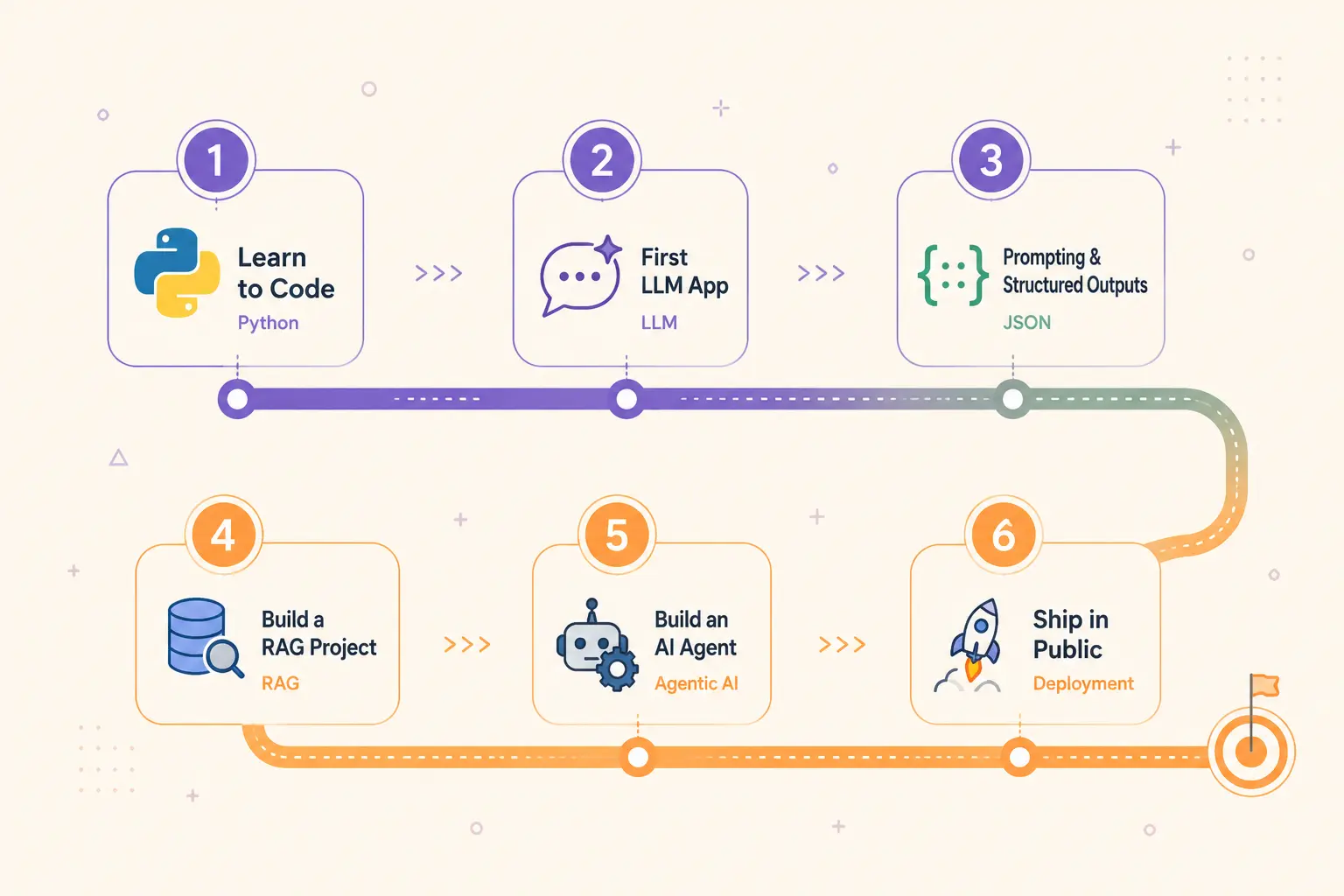
Total time: 3–6 months if you already code, 9–15 months from absolute zero. Each step below includes what to learn, what to build, and how you know you're done.
Step 1: Learn to code — 2–3 months (skip if you already program)#
Learn: Python (or TypeScript) fundamentals, HTTP APIs and JSON, virtual environments and package management, git.
Resources: Harvard's CS50P (free), Automate the Boring Stuff with Python (free online), freeCodeCamp.
Build: Three small scripts that call public APIs — a weather CLI, a currency converter, a script that pulls data from an API and writes a CSV.
You're done when: you can build and debug a small program that calls an external API without following a tutorial.
Step 2: Build your first LLM application — 1–2 weeks#
Learn: Getting an API key (Anthropic or OpenAI), making your first model call, streaming responses, counting tokens, and understanding your bill.
Build: Something tiny but real — a CLI that summarizes any article URL, a Telegram bot that answers questions, a commit-message generator. Resist the urge to use a framework; call the API directly so you understand the request/response loop.
You're done when: you can explain exactly what you're paying per request and why, and your app handles a failed API call gracefully.
Step 3: Master prompting and structured outputs — 2–3 weeks#
Learn: System prompts vs user messages, few-shot prompting, structured outputs with JSON schemas, handling refusals and edge cases. Work through Anthropic's prompt engineering documentation and interactive tutorial — it's free and genuinely excellent.
Build: A data extractor that takes messy real-world text (résumés, invoices, job postings) and outputs validated JSON. Then write your first eval: 20 test cases with expected outputs, scored automatically.
You're done when: changing your prompt and re-running your eval tells you objectively whether the change helped. This habit — evals before vibes — is the single best professional habit you can build early.
Step 4: Build a real RAG project — 3–4 weeks#
Learn: Embeddings, vector databases, chunking strategies, retrieval evaluation, citations.
Build: The classic portfolio piece — "chat with X" where X is a real document set you care about: a codebase, your country's tax guidance, a game's rulebook, university course materials. Implement chunking, embedding, semantic search, and source citations. Then break it on purpose: ask questions whose answers span two chunks, questions using synonyms the embeddings miss, and questions with no answer in the corpus (does it admit that, or hallucinate?).
You're done when: you can explain three ways RAG fails and demonstrate how you mitigated each one in your project. This is exactly what interviewers probe.
Step 5: Build an agent — 4–6 weeks#
Learn: Tool use / function calling, the agent loop (plan → act → observe → repeat), error recovery, loop limits and cost caps, and basic multi-agent patterns.
Build: An agent with real tools and a real goal. Strong options:
- A research agent that takes a company name, searches the web, reads pages, and produces a structured briefing
- A coding agent that reads failing tests, proposes fixes, applies them, and re-runs the tests
- An ops agent that triages incoming support emails, drafts replies, and escalates edge cases
You're done when: your agent recovers from at least one failure mode (empty search results, a tool error, a wrong turn) without human intervention, and has a hard cost ceiling per run. In 2026's job market, a working agent with visible engineering judgment gets more interviews than any certificate.
Step 6: Ship in public and write about it — ongoing#
Deploy one project where people can actually use it (Vercel, Railway, or a simple VPS). Then write about it — a blog post or detailed README covering what broke and how you fixed it. "My RAG bot hallucinated citations and here's the reranking fix that stopped it" is worth more to a hiring manager than any course completion badge, because it demonstrates the exact debugging judgment the job requires.
Repeat: build → break → fix → write. Three public projects with honest writeups constitute a hireable portfolio.
Your AI Engineering Tech Stack in 2026#
You don't need everything below — this is a menu, not a checklist. A sensible beginner stack is marked with ★.
| Layer | Options |
|---|---|
| Language | Python ★ or TypeScript |
| Model APIs | Anthropic Claude ★, OpenAI, Google Gemini |
| Frameworks | Raw API calls first ★, then Claude Agent SDK, LangChain/LangGraph, LlamaIndex |
| Vector DB | pgvector ★ (it's just Postgres), Chroma, Pinecone, Qdrant |
| Evals | Custom scripts ★, promptfoo, Braintrust, LangSmith |
| Deployment | Vercel ★, Railway, Fly.io, AWS |
| Observability | Structured logging ★, LangSmith, Helicone |
One strong opinion: learn raw API calls before any framework. Frameworks are productivity tools for people who understand what's underneath; for beginners they hide exactly the mechanics you're trying to learn.
Can You Become an AI Engineer Without a Degree?#
Yes — and this is more true for AI engineering than almost any other technical role, for three structural reasons:
- The field is barely three years old. Nobody has a decade of experience; there are no entrenched credential gatekeepers.
- Universities haven't caught up. Most CS curricula still teach classical ML; the RAG/agents/evals stack is learned from documentation, not lecture halls. Self-taught learners and CS graduates start from nearly the same line.
- The work produces public proof. A deployed agent with a writeup is verifiable evidence of skill in a way no transcript is.
What replaces the degree is a portfolio: two or three working projects (a RAG system, an agent, an eval suite), public code on GitHub, and written evidence that you can debug AI systems — not just assemble tutorials. Many working AI engineers today came from web development, DevOps, QA, or data analysis. The consistent pattern among those who transitioned successfully: they built real things and wrote honestly about the failures.
AI Engineer Salary Expectations in 2026#
AI engineering commands a clear premium over general software engineering, driven by demand far outstripping the supply of engineers who can ship reliable LLM systems (as opposed to impressive demos).
| Level | Typical US range |
|---|---|
| Entry / transition | $110K–$150K |
| Mid-level | $130K–$220K |
| Senior | $180K–$300K |
| Staff+ / AI-native companies | $300K+ |
Remote and international ranges vary widely, but the consistent pattern is a 15–30% premium over an equivalent backend role at the same company. Freelance AI engineering is also booming: businesses everywhere want custom chatbots, document automation, and internal agents, and rates of $80–$200/hour are common for engineers who can show shipped work.
Common Beginner Mistakes to Avoid#
- Starting with ML theory. You don't need to implement backpropagation to build AI products. Andrew Ng's ML course is wonderful — and mostly irrelevant to this role. Learn theory later, on demand.
- Framework-first learning. Starting with LangChain before understanding raw API calls means debugging abstractions you can't see through. Raw calls first, frameworks second.
- Skipping evals. The #1 professional gap. If you can't measure quality, you can't improve it — and you can't defend your work in a job interview.
- Building only chatbots. The market is saturated with thin chat UIs. Agents, automations, and domain-specific tools (legal, medical, logistics) stand out.
- Ignoring cost. A demo that costs $2 per user session isn't a product. Learn prompt caching and model routing (cheap model for easy requests, frontier model for hard ones) early.
- Tutorial hopping. Ten half-finished tutorials teach less than one project you built, broke, and fixed yourself.
- Waiting until you're "ready." The field moves too fast for complete preparation to exist. Everyone is learning in public; join them.
Frequently Asked Questions#
How long does it take to become an AI engineer?#
If you can already program: 3–6 months of focused building following the roadmap above. From absolute zero: 9–15 months, with most of the extra time spent on programming fundamentals. These assume consistent part-time effort (8–10 hours/week).
Is AI engineering a good career in 2026?#
Yes — it's one of the few tech specialties where demand still clearly exceeds supply. Every company adding AI features (which is nearly every company) needs engineers who understand prompts, RAG, agents, and evals. It's also unusually future-proof: as models improve, the engineering layer around them grows more valuable, not less.
Do I need math for AI engineering?#
Only light math. Unlike ML engineering, you're consuming models, not training them. Basic statistics helps for evals (what's a meaningful quality difference vs noise?); linear algebra and calculus are optional background.
Which programming language is best for AI engineering?#
Python for pipelines, tooling, and the widest tutorial ecosystem; TypeScript if you're building AI-powered web products. Both have first-class official SDKs from Anthropic, OpenAI, and Google. You can't go wrong with either — pick the one closest to your current skills.
What's the difference between AI engineering and prompt engineering?#
Prompt engineering is one skill inside AI engineering. AI engineers also build retrieval systems, tool integrations, agents, eval suites, and the production infrastructure around the model. "Prompt engineer" as a standalone job has largely folded into the broader AI engineer role.
Should I learn LangChain?#
Eventually, maybe — but not first. Learn raw API calls, then decide whether a framework earns its complexity for your use case. Many production teams use thin custom code instead of heavy frameworks.
Can I do AI engineering as a freelancer?#
Yes, and it's one of the strongest freelance niches in 2026. Small businesses want document automation, support bots, and internal agents but can't hire full-time. A portfolio of two shipped projects is enough to start taking clients.
Start Building Today#
AI engineering rewards builders over credential collectors. The entire barrier to entry is an API key and consistent effort: pick Step 2 from the roadmap, build something tiny this week, and let each project pull you into the next skill. The field is young enough that six months of consistent, public building puts you ahead of the vast majority of applicants — and the best time to have started was 2023, but the second-best time is today.
Looking for tools to build with? Browse our AI coding tools guide or explore the full AI tool directory.