How Do Large Language Models Work? A Beginner's Guide (2026)
I asked ChatGPT to help me plan a birthday party last month, and halfway through, I caught myself wondering: how does a pile of math actually know what a birthday party is? Not in a philosophical way — I mean mechanically. What is actually happening between me typing a sentence and it typing one back?
If you've ever had that same nagging question, this is the explanation I wish someone had given me before I went down a three-week rabbit hole of research papers. No math heavier than "a big list of numbers," no assumption that you've touched Python, and no pretending this stuff is simpler than it is. Just a straight walk through how a large language model actually works, end to end.
Start With the Trick, Not the Hype#
Here's the thing that made everything else click for me: an LLM does exactly one job. It looks at some text and predicts what word is most likely to come next.
That's it. That's the whole trick underneath ChatGPT, Claude, Gemini, and every other model you've heard of. Everyone's first reaction to that sentence is some version of "that can't be right, it clearly understands things." I had the same reaction. But stick with me, because the interesting part isn't the trick itself — it's what happens when you get shockingly good at that one trick, at a massive scale.
Think about how naturally you can finish someone's sentence. If a friend says "I'm so tired, I barely got any—" you already know the next word is "sleep" before they say it. You didn't need to think hard. Your brain has just seen that pattern so many times that the next word is obvious. An LLM does the same thing, except it's seen a genuinely staggering number of sentences — a meaningful fraction of the publicly available internet plus books, code, and articles — so its sense of "what word comes next" is unbelievably refined.
Computers Don't Read Words, They Read Numbers#
Before any prediction happens, your sentence has to become something a computer can actually work with, because computers only handle numbers.
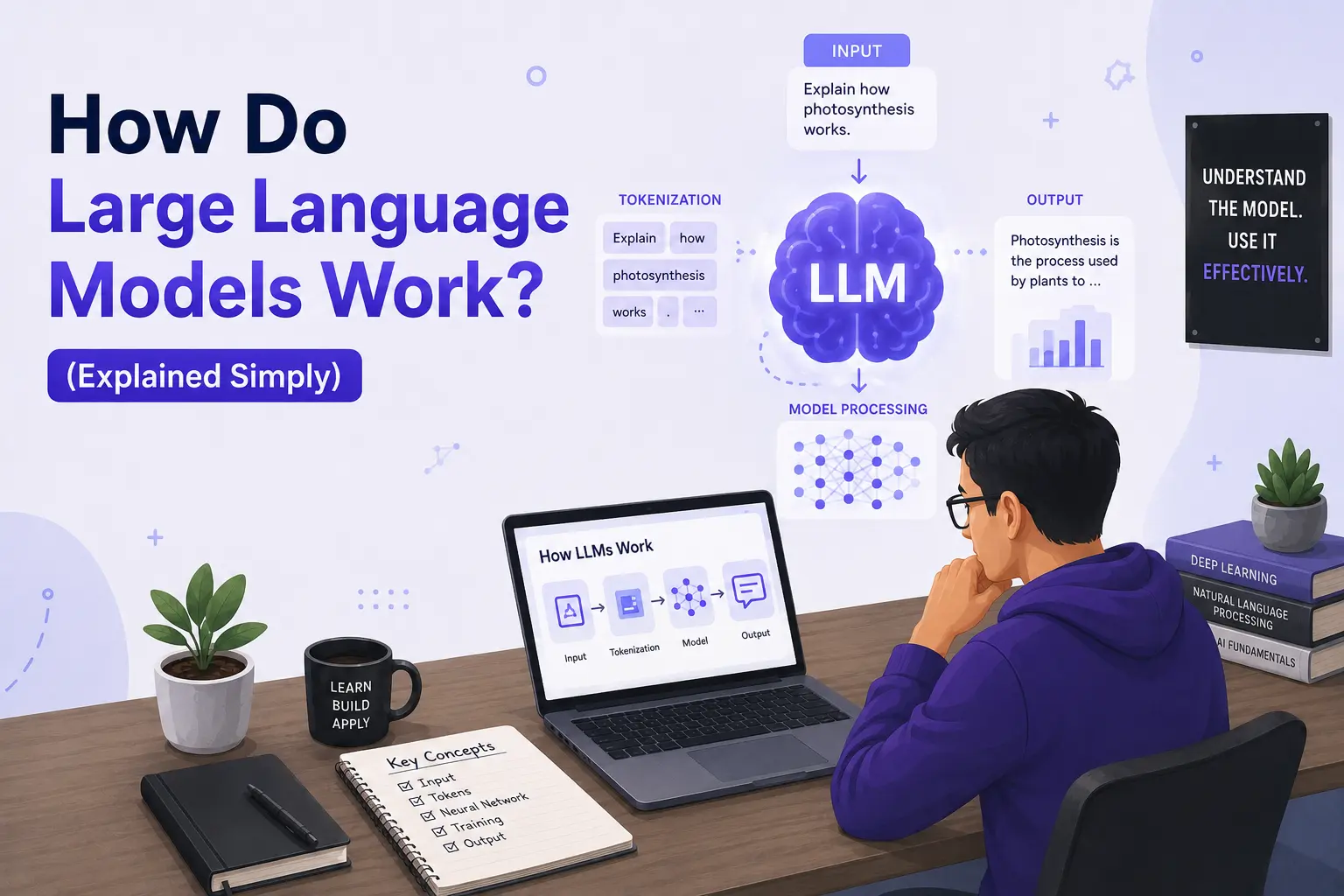
The first step is breaking your text into small chunks called tokens. A token is roughly a word, though longer words often get split into pieces — "unbelievable" might become "un," "believ," and "able" as three separate tokens. Short common words are usually one token each. This is why, if you've ever seen an AI product mention a "token limit" or charge you per token, this is the actual unit being counted — not words, not characters, tokens.
Each token then gets converted into a list of numbers called an embedding. This is where things get genuinely interesting instead of just being a technical detail. An embedding represents the meaning of a token as a location in space — and I mean that almost literally. Picture a map with thousands of dimensions instead of two. Words with similar meanings end up near each other on that map. "King" and "queen" sit close together. "Dog" and "puppy" sit close together. "Bank" (the financial kind) sits near "money," while "bank" (the riverside kind) sits near "river" — and yes, the model has learned to place the same word in different spots depending on context, which is part of how it handles words with multiple meanings without getting hopelessly confused.
This embedding step is why a model can tell that "I need to return this jacket" and "I want to send this jacket back" are asking for basically the same thing, even though they don't share a single meaningful word in common. It's not matching words. It's matching meaning.
The Part Everyone Struggles to Explain: Attention#
Okay, here's the part that took me the longest to actually get, so I'm going to spend real time on it: attention.
Say you're reading this sentence: "The trophy didn't fit in the suitcase because it was too big." Quick — what does "it" refer to? The trophy or the suitcase? You instantly know it's the trophy, because you understand that "too big" for an object means it doesn't fit into a container, not that a container is too big to hold something.
Now change one word: "The trophy didn't fit in the suitcase because it was too small." Now "it" refers to the suitcase. Same sentence structure, same position of the word "it," completely different meaning depending on one adjective at the end.
This is the exact problem attention solves. As the model processes each word, attention lets it look back at every other word in the sentence and decide how relevant each one is to understanding the current word. When it reaches "it," attention essentially asks every other word in the sentence "how relevant are you to figuring out what 'it' means here," and "big" or "small" light up as highly relevant while "the" and "in" barely register. This happens for every single word, looking at every other word, simultaneously.
This mechanism is the core innovation behind the "transformer" architecture — the "T" in GPT literally stands for Transformer — and it's the single biggest reason modern LLMs are so much better than older AI language systems from a decade ago. Older systems read text roughly left to right and struggled to connect a word to something mentioned much earlier in a long passage. Attention lets the model weigh the relevance of every word against every other word regardless of distance, which is why an LLM can still remember something you mentioned three paragraphs ago.
Stacking This Trick, Over and Over#
A single layer of "predict relevance, then predict the next word" wouldn't get you very far on its own. What makes modern models so capable is that this process — pay attention to relevant context, refine the meaning, predict — happens dozens of times in a row, stacked in layers, with each layer building a slightly richer understanding than the one before it.
Early layers tend to pick up on simple stuff — grammar, basic word relationships. Later layers build up to genuinely abstract patterns — tone, argument structure, even something that looks a lot like reasoning through a multi-step problem. Nobody explicitly programmed "understand sarcasm" or "follow a logical argument" into any specific layer. Those abilities emerged from the training process because getting good enough at next-word prediction, at a large enough scale, seems to require developing something that functionally resembles understanding.
I want to be honest that this is the part where AI researchers themselves get a little uncomfortable, because "it emerged from scale" is a genuinely strange thing to have to say about a piece of software. We can measure that it works. We can't always point to exactly why a specific ability showed up. That's not a marketing gap — that's an actual open question in the field.
Where All This "Knowledge" Actually Comes From#
None of what I've described so far explains why the model knows facts, writes code, or has opinions on your birthday party plans. That comes from training, and training happens in a couple of distinct stages.
Pretraining is the expensive, months-long part. The model is shown enormous quantities of text — again, we're talking a meaningful slice of the internet, digitized books, and code repositories — and for every single passage, it tries to predict the next token, checks whether it was right, and adjusts itself slightly based on how wrong it was. This happens billions of times. Each adjustment nudges the model's internal parameters — think of these as dials, and a large model has hundreds of billions of them — a tiny amount in the direction that would have made its prediction more accurate. Repeat that process at a large enough scale, for long enough, and a model that started out predicting gibberish gradually becomes one that can hold a coherent conversation.
Fine-tuning comes after, and it's a much smaller, more targeted stage. This is where a raw next-word predictor gets shaped into something that behaves like a helpful assistant rather than just an autocomplete engine. Humans write examples of good responses to instructions, and the model is trained further on those examples specifically. A related technique — reinforcement learning from human feedback — has people rank multiple model responses from best to worst, and the model gets nudged toward producing more of what humans preferred. This is the stage that turns "a model that can complete any sentence plausibly" into "a model that tries to actually help you and follows instructions."
If you skip fine-tuning, you get a model that might respond to "how do I fix a leaky faucet" with a plausible-sounding continuation of that sentence as if it appeared somewhere in a forum post — sometimes helpful, sometimes weirdly off-topic, and with no real sense that it's supposed to be assisting you specifically. Fine-tuning is what makes an LLM feel like it's talking to you instead of just talking near you.
So Why Does It Sometimes Confidently Make Things Up?#
This is probably the single most common question people have once they understand the basics, and the mechanical explanation actually makes hallucination make a lot more sense.
Remember, the model's entire job is producing the statistically most plausible next token given everything before it. It was never trained with a button that says "only say this if you're certain it's true." It was trained to be fluent and plausible, and fluency and truth usually line up because most of what's written on the internet is roughly accurate. But "usually" isn't "always," and when the model reaches a gap in what it actually learned, it doesn't stop and say "I don't know." It keeps doing the only thing it knows how to do: predicting the next most plausible token. The result reads exactly as confidently as everything else it writes, because from the model's perspective, there's no difference in how it generates a true sentence versus a fabricated one. Both come from the same prediction process.
This is also exactly why techniques like RAG (Retrieval-Augmented Generation) exist — instead of relying purely on what the model memorized during training, you hand it the actual relevant document at the moment you ask the question, so it's predicting the next word based on real, specific information sitting right in front of it rather than a fuzzy statistical impression from training. It's the difference between asking someone to recall a fact from memory versus handing them the document and asking them to summarize it.
Why Longer Conversations Get Expensive and Weird#
One more practical thing that makes a lot more sense once you understand tokens and attention: context windows. Every LLM has a limit on how many tokens it can consider at once — your entire conversation, plus its own response, all counted together. When people talk about a "1 million token context window," they're describing exactly that ceiling.
The reason this matters practically is that attention has to compare every token against every other token, so the computational cost grows quickly as the conversation gets longer. This is also why very long conversations sometimes feel like the model has "forgotten" something you said much earlier — depending on how the specific product manages context, older parts of a long conversation may get trimmed or summarized to make room for new messages, quite literally falling outside the window the model can see.
Putting the Whole Pipeline Together#
So here's the full path, start to finish: your text gets broken into tokens, each token becomes a list of numbers capturing its meaning, attention figures out how every word relates to every other word, that understanding gets refined through dozens of stacked layers, and the model predicts the single most probable next token. Then it does the exact same process again to predict the token after that, and again, and again, one token at a time, until it decides the response is complete. Every single thing an LLM has ever written to you, no matter how long or thoughtful it seems, was generated one token at a time, each one chosen because it was the statistically most plausible continuation given everything before it.
Knowing this mechanism doesn't make LLMs feel less impressive to me — if anything it's the opposite. Something this useful, this capable of holding a genuine conversation, emerging from "predict the next word, really really well" is a stranger and more interesting fact than any mystical explanation would have been.
If this made you curious about what it takes to actually build things on top of these models — prompts, retrieval, agents — that's the layer we cover in our guide on what AI engineering actually is, and our breakdown of what an AI agent is picks up exactly where this post leaves off, showing how an LLM becomes the "brain" inside a system that can actually take action.
Want to see LLMs in action across different products? Browse the AI chatbot tools in our directory to compare how different models handle the same kinds of conversations.