Single-Agent vs Multi-Agent Systems: When Do You Need a Team? (2026)
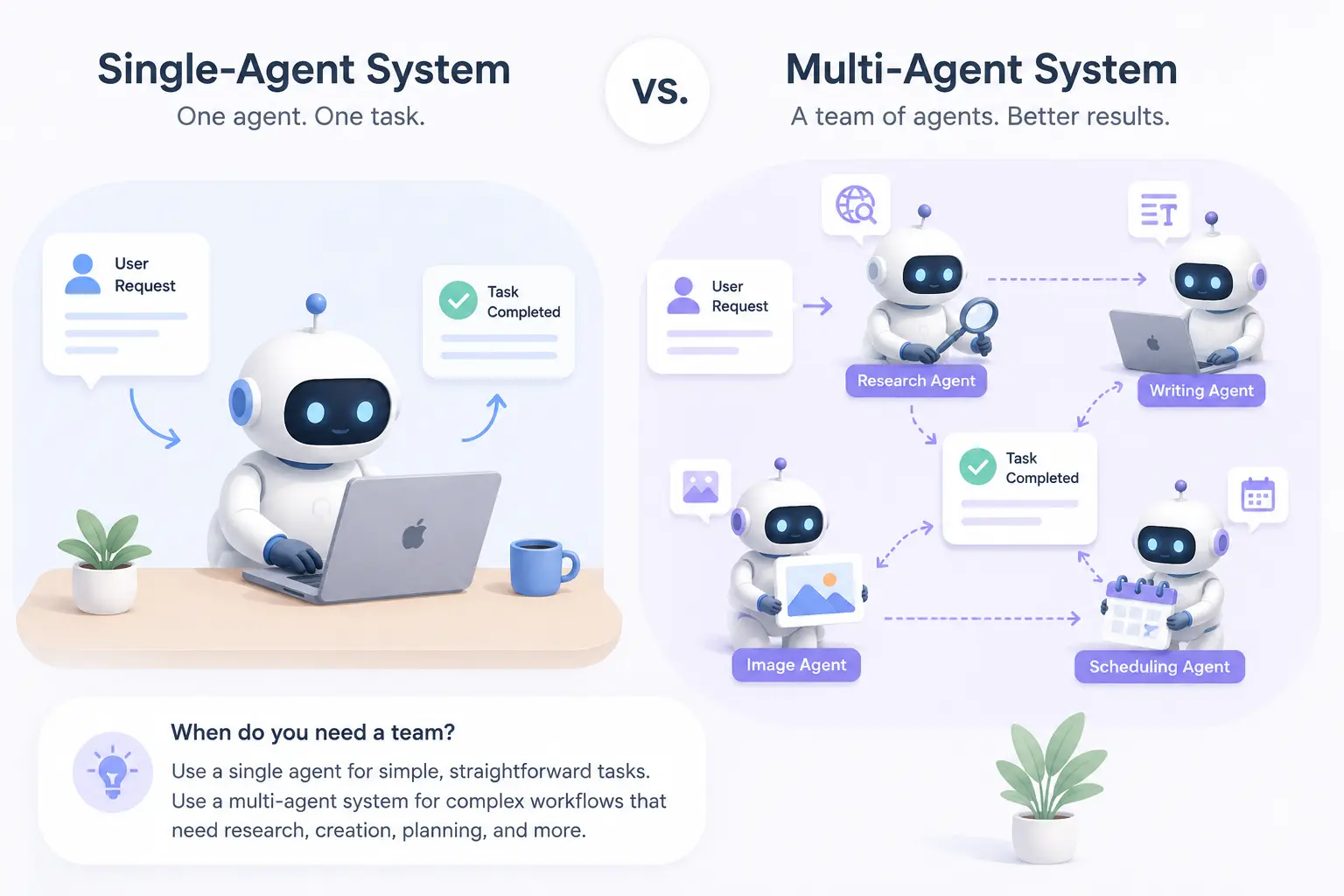
Here's the most expensive misconception in agent engineering right now: "one agent is good, so ten agents must be better."
Teams burn months building elaborate agent crews — a researcher, a writer, a critic, a manager, each with a persona — only to discover that a single well-built agent does the same job faster, cheaper, and with fewer bizarre failures. And yet, for the right problems, multi-agent systems genuinely are the unlock: parallel research sweeps, codebases too big for one context window, pipelines where specialization pays.
The skill is knowing which situation you're in. This guide — part of our series anchored by What Is an AI Agent? — explains how multi-agent systems actually work (collaboration, communication, delegation, orchestration), what they cost, and a decision framework that will usually tell you to start with one agent.
The Single Agent: Stronger Than You Think#
A single agent — one loop, one context, one toolbox (the full machinery from our architecture guide) — has quietly become very capable. Modern context windows hold enormous working state, reasoning models plan long tasks credibly, and tool calling covers most of what a "specialist" agent would do.
Its structural advantages are easy to underrate:
- Perfect information sharing. Everything the agent learned in step 3 is right there in step 40. No handoffs, no retelling, no version skew — one brain, one memory.
- Coherence. One planner means one consistent strategy and one writing voice in the output.
- Debuggability. When something goes wrong, there is one trace to read.
- Cost. One loop's worth of tokens, not five loops plus their coordination chatter.
A single agent's real limits are exactly three: context (the working state genuinely doesn't fit one window), parallelism (the task is many independent sub-tasks and wall-clock time matters), and role conflict (the same context that helps generation demonstrably hurts evaluation — a critic that watched the draft being written is a soft critic). If none of those three are biting, a team will not help you.
What a Multi-Agent System Actually Is#
A multi-agent system is several agent loops working toward one goal, connected by some structure. The four concepts from the spec sheet — collaboration, communication, delegation, orchestration — are best understood as the four design questions every such system must answer:
Collaboration — how does work combine?#
Agents don't collaborate like people; they combine outputs. The two honest patterns: division of labor (each agent owns a slice — one researches pricing, another reviews security — and an integrator merges results) and adversarial pairing (one generates, another critiques with fresh eyes — the fresh context is the entire point). Anything fancier than these two is usually theater.
Communication — how does information move?#
The central engineering problem. Options, in rising order of sophistication:
- Handoff: agent A's final output becomes agent B's input. Simple, lossy — B knows A's conclusions, not its dead ends.
- Shared workspace (blackboard): agents read and write a common artifact — files, a task board, a document. Communication becomes state, which is auditable and survives restarts. Most production systems live here.
- Direct messaging: agents converse mid-task. Powerful and dangerous — two LLMs can politely agree each other into nonsense, or loop forever. Use sparingly, with turn budgets.
Every channel loses information. The researcher's hunch that didn't make the summary is gone forever downstream — a loss the single agent never suffers. Managing what must cross the boundary is where memory design and communication design meet.
Delegation — who decides who does what?#
Delegation is a planning act: decompose the goal, then assign sub-tasks (the decomposition mechanics are the same as single-agent planning — the leaves just go to different workers). The delegator must also write the brief: a sub-agent starts cold, so its instructions need the goal, the constraints, and the context it can't otherwise see. Vague briefs are the #1 multi-agent failure — the sub-agent confidently does the wrong thing, exactly like a contractor with a bad spec.
Orchestration — what shape does the team take?#
Four patterns cover nearly every real system:
- Orchestrator–workers. A lead agent plans, spawns specialized sub-agents, integrates their results. The dominant pattern — it keeps one mind responsible for the whole while parallelizing the parts. This is how modern coding agents use sub-agents for research-heavy side quests.
- Pipeline. Fixed stages: research → draft → edit → fact-check. Predictable, auditable; best when the workflow itself is stable.
- Generator–critic (debate). Producer and evaluator with separate contexts; iterate until the critic passes it. Cheap quality insurance for high-stakes output.
- Swarm. Many identical agents attack shards of a huge task in parallel — reviewing 500 files, checking 200 sources. Pure parallelism, minimal interaction; results merge mechanically.
 Image to place: four small schematics in a 2×2 grid — orchestrator-workers (star), pipeline (chain), generator-critic (two nodes with a feedback arrow), swarm (many parallel nodes merging). Path:
 public/blogsimages/aiagent/single-agent-vs-multi-agent-systems/diagram-1.webp
The Honest Comparison#
| Single agent | Multi-agent system | |
|---|---|---|
| Information | One context — nothing lost | Split contexts — every handoff loses detail |
| Speed | Sequential | Parallel where the task allows it |
| Working state | Bounded by one context window | Effectively unbounded across agents |
| Coherence | One plan, one voice | Integration step must rebuild it |
| Cost | One loop | N loops + orchestration overhead (often 3–15×) |
| Debugging | One trace | Interleaved traces; failures can cascade |
| Best at | Judgment-dense, tightly-coupled work | Wide, parallel, or role-separated work |
And the failure modes teams actually hit: coordination overhead eating the parallelism win; cascading errors (one worker's mistake polluting every downstream step — reflection checkpoints between stages are the fix); context fragmentation (the answer existed, but split across two agents that never compared notes); and cost surprises — the most common retro is "we replaced it with one good agent and quality went up."
The Decision Framework#
Ask in order — and stop at the first "no":
- Does a single well-built agent demonstrably fail here? Not "feels small" — demonstrably: context overflowing, wall-clock too slow, or generation contaminating evaluation. If no: single agent. Done.
- Is the bottleneck parallelism? → Swarm or orchestrator–workers.
- Is it role conflict? → Generator–critic.
- Is it a stable, staged workflow? → Pipeline.
- Still unsure? → Orchestrator–workers, the safest general shape — but start with two agents, not seven.
The pattern in every mature team's journey: start with one agent, add a second only when you can name the failure it fixes, and let the roster grow from evidence, not org-chart fantasy. (If you're evaluating frameworks for either path — LangGraph, CrewAI, AutoGen and friends — Best AI Agent Frameworks in 2026 compares how each handles orchestration.)
FAQ#
Are multi-agent systems smarter than single agents? No — same models underneath. A team changes structure (parallelism, fresh contexts, unbounded total state), not intelligence. Structure only helps when structure was the problem.
Isn't an agent calling a sub-agent just a tool call? Mechanically yes — and that's the healthiest way to think about it. A sub-agent is a tool that happens to contain a loop. The orchestrator remains one accountable mind.
How many agents do real production systems use? Fewer than the demos suggest. The most common production shapes in 2026 are one agent, one agent + critic, and one orchestrator with 2–5 ephemeral workers. Ten-persona crews are conference-talk architecture.
Do agent teams need different models? Often a smart orchestrator model with cheaper worker models is the cost-optimal mix — the orchestrator does the judgment, workers do bounded lookups and transformations.
Keep Learning#
Part of the FindUrAI AI Agent series:
- The pillar: What Is an AI Agent? Complete Beginner Guide
- How AI Agents Work: Complete Architecture Explained — the single loop every team is made of
- AI Agent Planning Explained — decomposition and delegation share the same machinery
- AI Agent Memory Explained — shared workspaces and what handoffs lose
- AI Agent vs AI Assistant — where control sits between human and agent
Also in this series: Best AI Agent Frameworks in 2026 — how LangGraph, CrewAI, AutoGen and others implement these orchestration patterns.