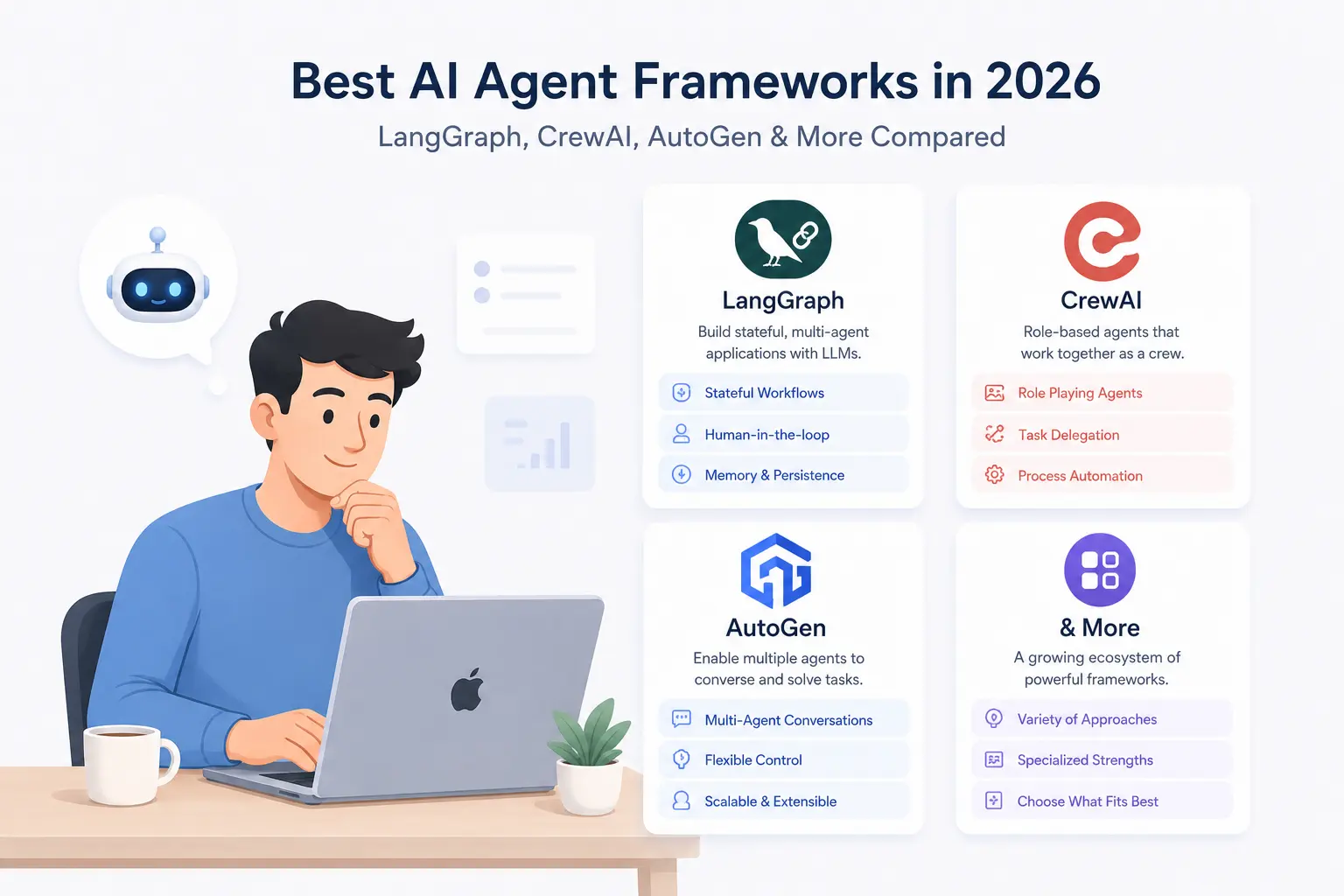
Best AI Agent Frameworks in 2026: LangGraph, CrewAI, AutoGen & More Compared
Two years ago, "agent framework" meant a weekend hack around a while-loop. In 2026, it's a crowded, fast-moving category where every option ships durable state, sub-agents, human-in-the-loop hooks and tracing — and where picking wrong means rewriting your orchestration layer six months in.
This guide compares the six frameworks everyone shortlists — LangGraph, CrewAI, AutoGen, OpenAI Agents SDK, SmolAgents and PydanticAI — plus the vendor SDKs increasingly eating their lunch. No sponsored rankings, no feature-matrix fog: what each one is actually good at, where it hurts, and a decision guide at the end.
New to agents? Start with our pillar guide, What Is an AI Agent? — this article assumes you know the core architecture: the loop, tools, memory and planning.
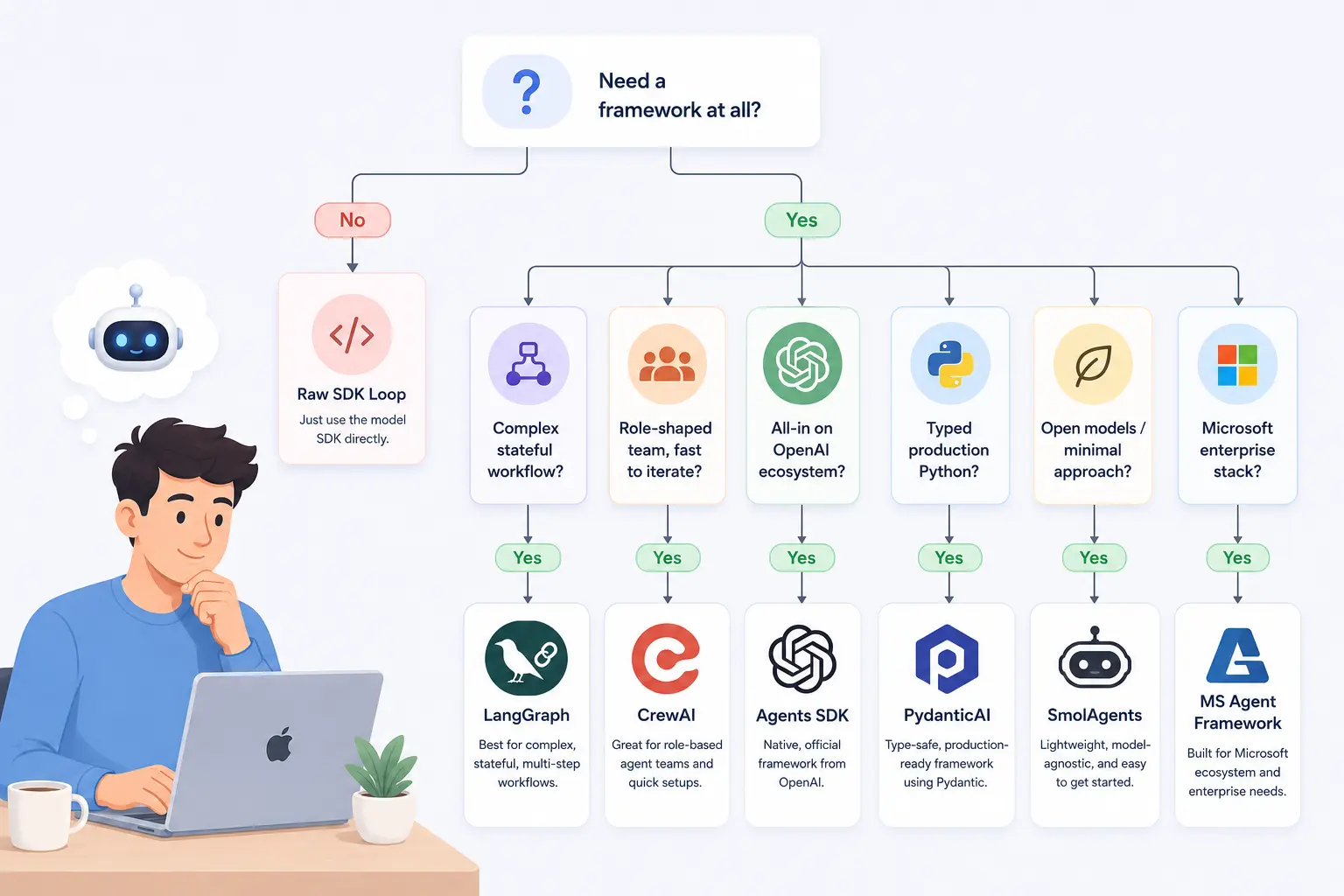
First Question: Do You Need a Framework at All?#
Unpopular truth: a basic agent is ~50 lines of code. A loop that sends context to a model API, executes the tool calls it returns, and feeds results back — that's the whole trick, and every model provider's SDK handles the tool-calling plumbing natively.
You don't need a framework for: one agent, a handful of tools, short tasks, a single model provider. You start wanting one when you hit: durable state (tasks that survive restarts), human approval gates, sub-agent orchestration, retries and branching logic, observability across hundreds of runs, or team standardization.
Frameworks are orchestration insurance. Buy the insurance when you have something to insure.
How to Judge an Agent Framework in 2026#
Four axes separate the contenders:
- Orchestration model — graphs, roles, conversations, or plain code? This shapes everything you'll build.
- Production readiness — durable execution, state persistence, tracing, deployment story.
- Learning curve vs control — the eternal trade-off; you generally get one at the expense of the other.
- Lock-in surface — how hard is leaving? Abstractions that wrap everything cost the most to escape.
The Comparison at a Glance#
| Framework | Orchestration model | Learning curve | Best for | Watch out for |
|---|---|---|---|---|
| LangGraph | Explicit graph (nodes/edges) | Steep | Complex stateful workflows, human-in-the-loop | Overkill for simple agents |
| CrewAI | Role-based crews + Flows | Easiest | Fast multi-agent prototypes, role-shaped work | Less control when you outgrow the abstractions |
| AutoGen / AG2 | Conversational agents | Medium | Research, experimentation | Legacy path — ecosystem moved to successors |
| OpenAI Agents SDK | Minimal: agents + handoffs | Easy | Single agents on OpenAI, fast production path | Vendor-centric by design |
| SmolAgents | Code-as-action, minimal | Easy | Open-model agents, hackable minimalism | Thin production tooling |
| PydanticAI | Typed agents, plain Python | Easy–medium | Type-safe production Python, structured outputs | Younger orchestration story |
LangGraph — The Production Workhorse#
What it is: LangChain's agent runtime, now past 1.0, where you model an agent (or team) as an explicit graph — nodes are steps, edges are transitions, cycles are allowed, and state is a first-class, persisted object.
Why people choose it: control and durability. Checkpointing means a workflow can pause for a human approval on Tuesday and resume Thursday exactly where it stopped — the human-in-the-loop and reflection patterns fall out of the graph model naturally rather than being bolted on. It's the most production-proven of the open frameworks, with the deepest observability ecosystem (LangSmith).
Why people leave it: ceremony. Simple agents feel heavy when expressed as graphs, and the learning curve is the steepest here. If your workflow is "call tools in a loop until done," LangGraph is a cathedral for a garden shed.
Choose it when: workflows have branches, cycles, approval gates, or must survive restarts — the "this is real infrastructure now" moment.
CrewAI — The Fast Lane to Multi-Agent#
What it is: the framework that made role-based orchestration mainstream: define agents as roles (researcher, analyst, writer) with goals and tools, group them into a crew, and let them work through tasks. Now mature (1.x), with Flows adding the deterministic, event-driven control its early versions lacked.
Why people choose it: speed to something impressive. A working multi-agent crew takes an afternoon, and the role mental model matches how non-ML stakeholders think, which makes it an outstanding prototyping and demo framework. It's also standalone — no LangChain dependency.
Why people leave it: the abstractions that make it fast also make it opinionated. When you need precise control over context, memory or unusual orchestration shapes, you start fighting the framework — the classic trade-off from our single vs multi-agent guide: role-shaped teams are one pattern, not all of them.
Choose it when: the work genuinely splits into specialist roles, and iteration speed matters more than fine-grained control.
AutoGen / AG2 — The Research Pioneer, Now a Legacy Path#
What it is: Microsoft Research's framework that pioneered conversation-as-orchestration — agents coordinate by talking to each other, including the famous two-agent pattern where a coder agent and executor agent iterate until code runs.
The honest 2026 status: AutoGen's ideas won, but the project itself split. The community continues it as AG2, while Microsoft's official energy moved into the Microsoft Agent Framework — the enterprise-grade convergence of AutoGen and Semantic Kernel, now the recommended path on Azure/.NET stacks. Existing AutoGen codebases run fine; new projects should think twice before starting on the legacy line.
Choose it when: you're doing research-style experimentation with conversational multi-agent patterns, or maintaining an existing AutoGen system. For new enterprise builds in the Microsoft ecosystem, evaluate Microsoft Agent Framework instead.
OpenAI Agents SDK — The Minimal Vendor Path#
What it is: OpenAI's official, deliberately small agent SDK (successor to the Swarm experiment): agents (model + instructions + tools), handoffs (agents delegating to agents), guardrails (validating inputs/outputs), and built-in sessions and tracing. A few primitives, shallow learning curve, production-supported.
Why people choose it: it's the fastest path from idea to working, traceable agent if you're on OpenAI models — the tool loop, state and observability are handled without a heavyweight abstraction layer. This "vendor SDK instead of framework" pattern is one of 2026's big shifts (Anthropic's Claude Agent SDK plays the same role on the other side of the fence).
Why people hesitate: it's vendor-centric by design. Other models can be wired in, but you're swimming with the current only on OpenAI.
Choose it when: you're committed to OpenAI models and want production basics with minimal ceremony.
SmolAgents — Minimalism, Open Models, Code as Action#
What it is: Hugging Face's tiny framework (~small-enough-to-read core) with one genuinely different idea: agents that write their actions as Python code instead of JSON tool calls. One code block can chain several operations — often fewer, richer steps than call-by-call tool use.
Why people choose it: hackability and the open ecosystem. First-class support for open-weight models via Hugging Face, sandboxed code execution, and a codebase you can actually understand end to end — which makes it a superb learning framework as well as a capable light one.
Why people hesitate: production scaffolding (durable state, enterprise observability) is thinner than LangGraph's, and code-as-action demands serious sandboxing discipline.
Choose it when: you want maximum transparency, open models, or an educational codebase — and your production demands are modest.
PydanticAI — Type Safety as a Feature#
What it is: an agent framework from the Pydantic team (the validation library underneath half the Python AI ecosystem), now in its second major version. Agents are typed: structured outputs validated by Pydantic models, dependency injection for tools, and a "FastAPI feeling" for agent development — plain Python control flow instead of a DSL, plus Logfire integration for observability and a growing evals story.
Why people choose it: reliability engineering. When an agent's output feeds real systems, "the model returned something shaped exactly like this schema, or we retried" is worth a great deal. Model-agnostic across every major provider.
Why people hesitate: orchestration for complex multi-agent shapes is younger than LangGraph's, and the framework itself is newer than the incumbents.
Choose it when: you're building production Python where structured, validated outputs and testability matter more than exotic orchestration.
Also Worth Knowing in 2026#
- Claude Agent SDK (Anthropic) — the harness that powers Claude Code, exposed as an SDK; arguably the strongest vendor-native path for long-running, tool-heavy agents on Claude models.
- Microsoft Agent Framework — AutoGen + Semantic Kernel, converged and enterprise-hardened; the default conversation in .NET/Azure shops.
- LlamaIndex Workflows — event-driven agent workflows with the best RAG integration in the business; natural pick when your agent is retrieval-first (see our RAG guide).
The Decision Guide#
- "I'm learning agents" → build one with no framework first (it's the best lesson in the architecture), then SmolAgents or PydanticAI.
- "I need a demo by Friday that impresses stakeholders" → CrewAI.
- "This is production infrastructure with approvals and long-running state" → LangGraph.
- "Single capable agent, we're an OpenAI shop" → OpenAI Agents SDK. Anthropic shop → Claude Agent SDK.
- "Output feeds real systems; correctness over cleverness" → PydanticAI.
- "Microsoft enterprise" → Microsoft Agent Framework.
- "Open-weight models, full transparency" → SmolAgents.
And a portability tip that outlives any ranking: keep your tools and prompts framework-agnostic (plain functions, plain strings — or MCP servers, per our Model Context Protocol guide) so the framework remains a replaceable orchestration layer, not the skeleton of your product.
FAQ#
Which framework is most popular in 2026? By search interest and production adoption, LangGraph leads, with CrewAI and the AutoGen lineage following. Popularity is a hiring signal, not a fitness signal — match the orchestration model to your problem first.
Python or JavaScript? Python remains the center of gravity (all six here are Python-first; LangGraph and the OpenAI SDK have JS/TS versions). If your team is TS-native, also look at the vendor SDKs' TS support before committing.
Can I mix frameworks? More reasonable than it sounds: tools speak MCP, and a sub-agent is ultimately "a thing you call with a task" — teams increasingly run e.g. a LangGraph orchestrator that invokes a PydanticAI-built specialist. Keep interfaces clean and it's fine.
Do frameworks matter more than models? No — model quality dominates outcomes. The framework decides how much engineering pain sits between the model and production, not how smart your agent is.
Keep Learning#
Part of the FindUrAI AI Agent series:
- The pillar: What Is an AI Agent? Complete Beginner Guide
- How AI Agents Work: Complete Architecture Explained — what every framework implements underneath
- Single-Agent vs Multi-Agent Systems — the orchestration patterns these frameworks encode
- AI Agent Planning Explained — plan-and-execute, ReAct, and human-in-the-loop
- Model Context Protocol (MCP) Guide — framework-agnostic tools
Coming next in this series: How to Build Your First AI Agent — a step-by-step tutorial putting one of these frameworks to work.