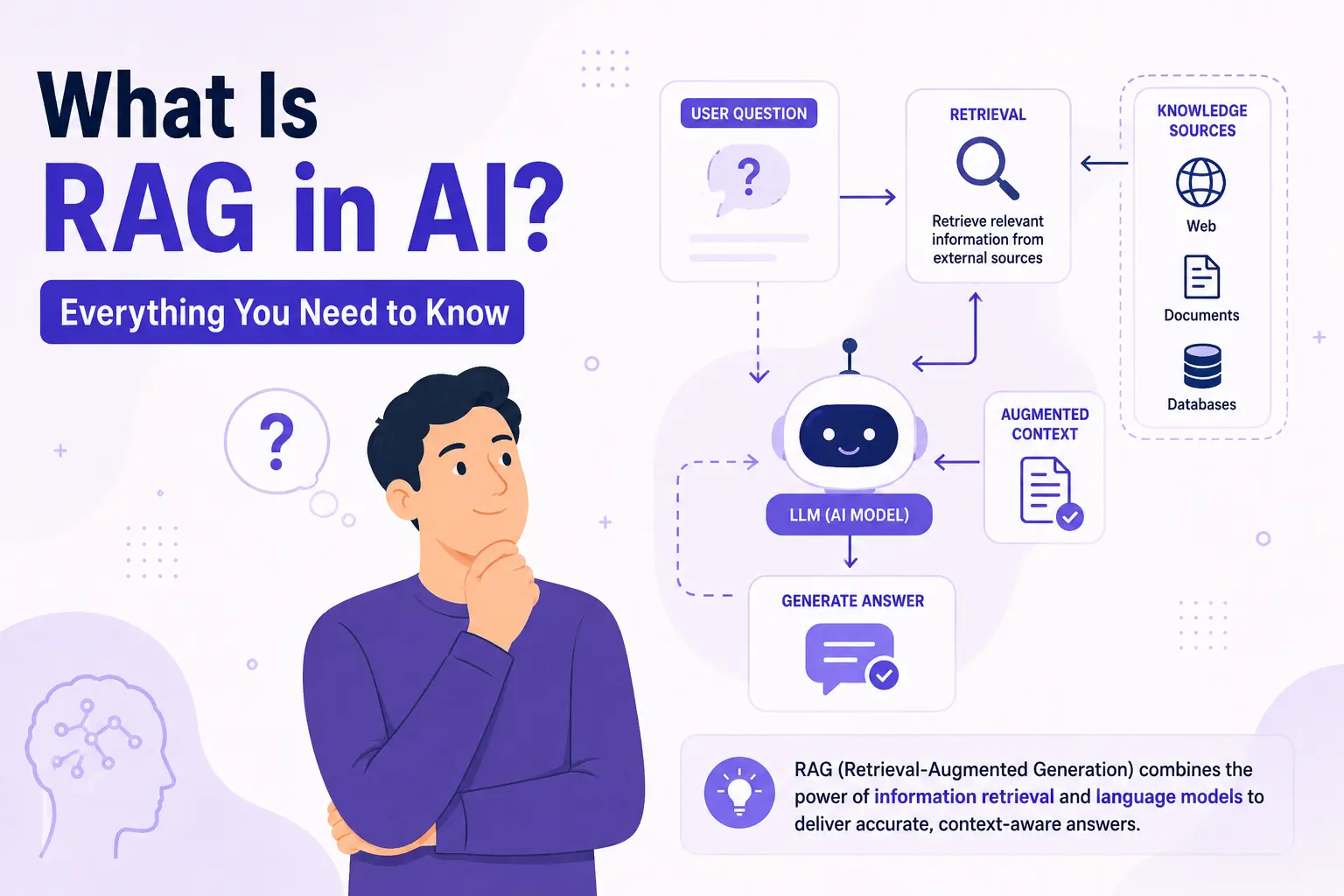
What Is RAG in AI? Everything You Need to Know (2026 Guide)
A few months back I asked an internal company chatbot what our refund policy was, and it confidently told me we offered 60-day returns. We didn't. We never had. It wasn't lying exactly — it was doing what language models do, which is producing the most plausible-sounding answer based on patterns from its training, and "60-day returns" is an extremely common policy across e-commerce in general. It just wasn't our policy.
That's the exact problem RAG exists to solve, and once you see it framed that way, the whole concept stops feeling like a buzzword and starts feeling like the obvious fix it actually is. If you've been seeing "RAG" thrown around in every AI product announcement and nodding along without really knowing what it means, this is the explanation that should finally make it click.
The Problem RAG Is Actually Solving#
Here's the thing worth understanding before anything else: a language model's knowledge is frozen at the moment its training finished, and that knowledge is a fuzzy statistical impression of everything it read, not a lookup table of exact facts. Ask it about something genuinely common and well-documented across the internet, and it'll usually get close. Ask it about your company's specific refund policy, a document that only exists on your internal wiki, or anything that happened after its training cutoff, and it has nothing real to draw from — but it was never trained to say "I don't know." It was trained to keep predicting the next most plausible word regardless. So it does, confidently, and the result sounds exactly as fluent as everything else it says.
This gets called "hallucination," and if you want the deeper mechanical explanation of why it happens, I got into that in how large language models actually work — but the short version is that a model generating a fabricated answer and a model generating a true one go through the exact same process internally. There's no little warning light that flips on when it's guessing.
RAG's entire premise is refreshingly simple once you strip away the acronym: instead of asking the model to recall facts from its fuzzy training memory, you hand it the actual relevant document at the moment you ask the question, and tell it to answer based on what's right in front of it. That's it. That's the whole idea. Everything else is implementation detail.
The Analogy That Actually Makes This Click#
Think about the difference between a closed-book exam and an open-book exam. In a closed-book exam, you're relying entirely on what you memorized beforehand, and if you memorized it slightly wrong or never learned it in the first place, you're going to write down something plausible-sounding but incorrect with total confidence, because you have no way to check yourself against a source.
An open-book exam is a completely different task. You're not relying on memory anymore — you're finding the relevant page, reading it, and answering based on what's actually written there. You can still get it wrong if you misread the passage, but you're dramatically less likely to just invent an answer out of nowhere, because the actual source material is sitting right in front of you the whole time.
A plain LLM answering a question is taking a closed-book exam on every single topic, all the time, whether it studied that topic well or not. RAG turns it into an open-book exam by handing it the specific, relevant page right before it answers.
RAG Spelled Out, Piece by Piece#
The name itself is actually a pretty accurate description once you break it into its three words:
Retrieval means finding the relevant information from some larger collection of documents — your company's policy docs, a knowledge base, a set of research papers, whatever body of knowledge you're working with.
Augmented means that retrieved information gets added into the conversation, injected alongside your question before the model ever starts generating a response.
Generation is just the normal thing an LLM does — producing a fluent, well-written answer — except now it's generating that answer with the real source material sitting in its context instead of relying purely on trained-in memory.
Put together: search for the relevant facts, hand them to the model, then let the model write a good answer using those facts. The cleverness isn't in any single step — it's in the fact that combining them fixes a problem that neither step solves on its own. Search engines find documents but don't write conversational answers. LLMs write great conversational answers but can't reliably recall specific facts. RAG is the seam where those two things meet.
How Retrieval Actually Finds the Right Document#
Here's where the real engineering happens, and it's worth understanding because it explains both why RAG works so well and why it sometimes doesn't.
You can't just have the model search a huge pile of documents for exact keyword matches, because people don't ask questions using the same words the documents use. Someone might ask "can I send this back" while the policy document says "returns and refunds," and a basic keyword search would completely miss that these are the same question.
This is solved with embeddings — the same concept from how LLMs represent meaning internally, but applied here to entire chunks of text instead of individual words. Every document in your knowledge base gets converted into a list of numbers that represents its meaning as a location in a huge mathematical space, where similar meanings end up near each other regardless of the exact words used. Your question gets converted into that same kind of number list. Then the system just finds whichever stored documents sit closest to your question in that space — a vector database (tools like Pinecone, Weaviate, or pgvector exist specifically for storing and searching these efficiently) does that "find the closest matches" search, typically across millions of stored chunks, in a fraction of a second.
This is why "can I send this back" successfully retrieves a document titled "Returns and Refunds Policy" even though they don't share a single word. The system isn't matching text. It's matching meaning, which is exactly the trick that makes retrieval useful instead of just being a fancier keyword search.
Why Chunking Is the Unglamorous Part That Determines Everything#
Before any of that retrieval magic happens, your documents have to be broken into smaller pieces called chunks, because you don't want to hand an LLM your entire 40-page policy manual every time someone asks a simple question — it's wasteful, slow, and buries the relevant sentence in a mountain of irrelevant context.
This sounds like a boring implementation detail, and it's actually the single most common place RAG systems quietly break. If a document gets sliced right in the middle of a table, or right between a question and its answer in an FAQ, the resulting chunk loses the context that made it meaningful in the first place, and the embedding built from that broken chunk won't represent what the original passage actually meant. I've seen a RAG system fail to answer a genuinely simple question, not because retrieval or generation was broken, but because the source document got chopped at exactly the wrong sentence during setup, months earlier, by someone who never thought about it again.
Good chunking respects the natural structure of a document — keeping a full paragraph together, keeping a table intact, keeping a question paired with its answer — rather than just splitting every 500 characters regardless of what's on the page. It's unglamorous work, but it's usually the actual difference between a RAG system that feels magical and one that feels randomly unreliable.
Putting the Whole Pipeline Together#
Here's the full path a question actually takes, start to finish. You ask something. Your question gets converted into that meaning-based number representation. The system searches the vector database for the stored document chunks whose meaning is closest to your question. The handful of best-matching chunks — usually somewhere between three and ten, depending on the setup — get pulled out and inserted into the prompt alongside your original question, typically with an instruction like "answer the question using only the following information." Then the LLM generates its response, the same way it always does, except this time the actual source material is sitting directly in its context instead of being something it has to recall from fuzzy training.
The end-to-end effect is that the model's tone, writing quality, and reasoning ability stay exactly the same as they always were — that's all still coming from the underlying LLM — but its factual grounding comes from documents you control, updated whenever you want, rather than from whatever it happened to absorb during training a year or more ago.
RAG vs Fine-Tuning: The Question Everyone Mixes Up#
This is probably the single most common confusion I run into when people are first learning this stuff, so it's worth addressing directly. Fine-tuning and RAG solve genuinely different problems, even though both get pitched as ways to make a model "know more" about something specific.
Fine-tuning actually retrains the model further on your specific examples, adjusting its internal parameters so it develops a new pattern of behavior — a particular tone, a particular writing style, a particular way of formatting responses. It's expensive, it's slow to update, and once it's done, the knowledge is baked into the model itself.
RAG doesn't change the model at all. It changes what the model sees at the moment it's answering. That makes it dramatically cheaper to keep current — if your refund policy changes tomorrow, you update one document, and every future answer reflects that instantly. Try that with fine-tuning and you're re-running an expensive training process.
The rule of thumb I actually use: if the problem is "the model doesn't know a fact," that's almost always a RAG problem — feed it the fact. If the problem is "the model knows the fact but writes about it in the wrong tone, format, or style," that's a fine-tuning problem. Most real-world business chatbot use cases are the first kind, which is exactly why RAG has become the dominant pattern rather than fine-tuning for company-specific knowledge.
Where RAG Actually Shows Up#
If you've used any of these, you've already used RAG without necessarily knowing the term:
- "Chat with your PDF" tools — the document gets chunked and embedded, and every question you ask retrieves the relevant page before answering.
- Company support chatbots — retrieving your actual policies, product docs, and past ticket resolutions instead of guessing.
- AI search engines that cite sources — retrieving current web pages and generating an answer grounded in what they found, which is also why they can answer questions about things that happened after the model's training cutoff.
- Internal "ask the company wiki" assistants — the exact use case that started this whole post, when it's built well.
This is also a core building block inside AI agents — an agent that needs to answer from your specific knowledge base rather than its general training is almost always running a RAG step somewhere in its loop before it responds.
Why RAG Still Isn't a Magic Fix#
I don't want to leave you with the impression that bolting RAG onto anything instantly solves hallucination, because it doesn't, and the caveats matter as much as the concept.
Retrieval can miss the right document entirely, especially if the chunking was done poorly or the question is phrased in a genuinely unusual way. The model can also be handed the correct document and still misread or misinterpret it — an open-book exam only helps if you actually read the passage correctly, and models occasionally still get that wrong. And if your underlying documents are themselves outdated or wrong, RAG will confidently retrieve and repeat that wrong information just as fluently as it would repeat correct information. RAG fixes the "no source at all" problem. It doesn't fix a bad source, and it doesn't guarantee perfect reading comprehension every single time.
The Honest Summary#
RAG is the fix for the closed-book exam problem — instead of trusting an LLM's fuzzy trained-in memory for facts specific to you, you hand it the real, current, relevant document right before it answers. Retrieval finds the right chunk by matching meaning rather than exact words, generation writes the actual answer using that chunk as grounding, and the two together solve a problem that neither one solves alone. It's not infallible, and the unglamorous parts — chunking, retrieval quality — usually matter more than people expect going in. But it's the reason a well-built company chatbot can tell you your actual return policy instead of confidently making one up.
If this is the piece that was missing before agents and AI engineering made full sense, our guides on what AI engineering actually is and what an AI agent is pick up right where this leaves off.
Curious about tools that use RAG under the hood? Browse AI search and research tools in our directory to see it in action.